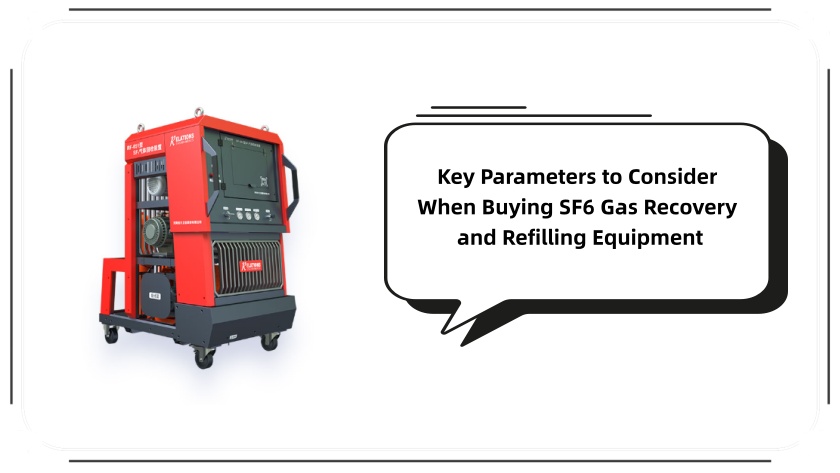
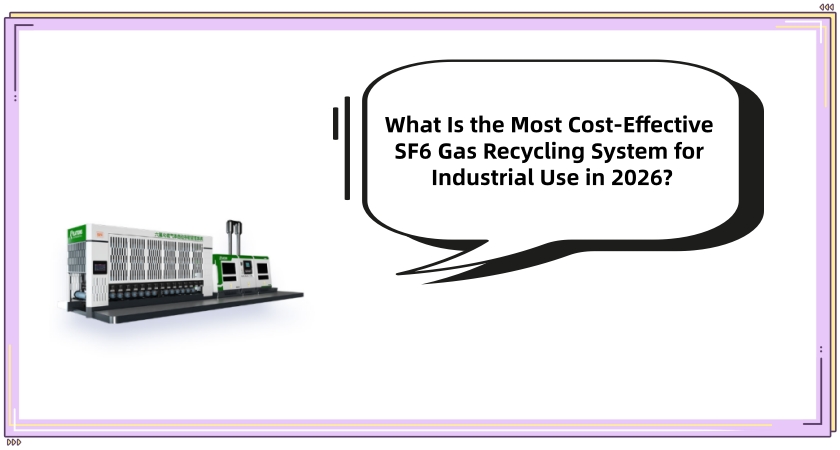
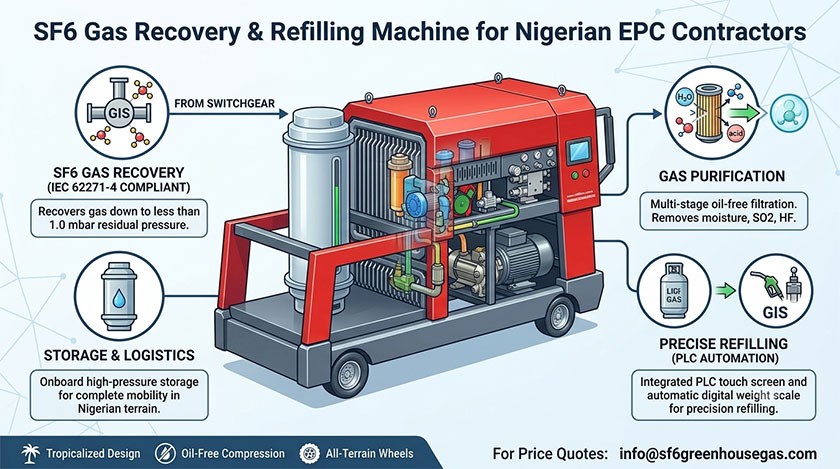
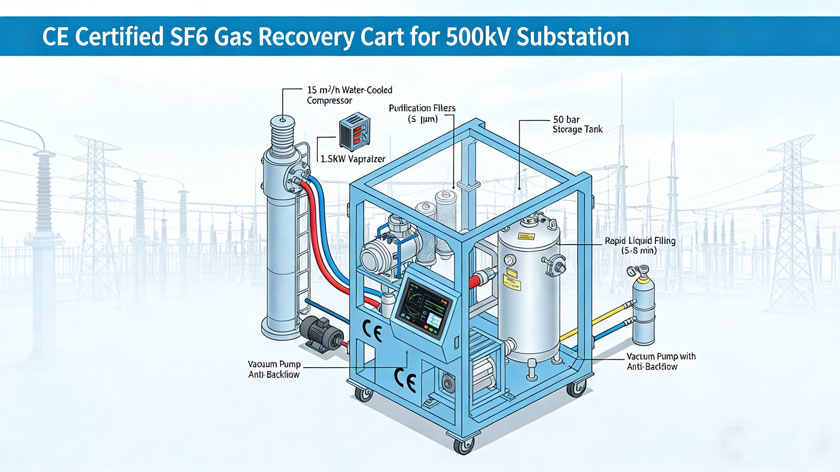
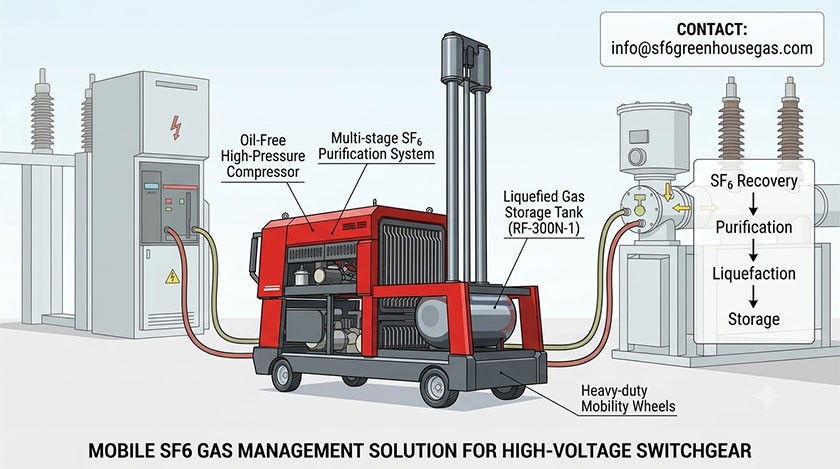
When investing in SF6 gas recovery and refilling equipment, choosing the wrong parameters can lead to costly issues—from failed compliance with global standards (like IEC 60480 or EU F-Gas Regulation) to inefficient gas reuse and increased operational downtime. This guide breaks down the critical technical, safety, and cost-related parameters you must evaluate to match equipment to your needs (e.g., low-voltage vs. high-voltage applications) and rank for user search intent like “what to look for when buying SF6 recovery equipment” or “SF6 refilling equipment parameters.”
1. Technical Performance Parameters (Core for Equipment Functionality)
Technical specs directly determine if the equipment can handle your SF6-related tasks (e.g., recovering gas from 110kV GIS or refilling circuit breakers).
1.1 Recovery Efficiency
Key Requirement: Aim for a recovery rate of 95%–99% (per IEC 60480) and final residual pressure ≤50 kPa. For high-voltage systems (≥72.5 kV), prioritize rates ≥100 kg/h (e.g., Enervac’s systems).
Why It Matters: Low recovery rates leave unused SF6 in equipment, increasing waste and violating emission rules (e.g., EU F-Gas bans on excess leakage).
Example: A Globe Instrument RF-391 (portable) handles 50 kg/h—ideal for 10–40.5 kV medium-voltage gear, while Enervac’s industrial units process 300 kg/week for large power plants.
1.2 SF6 Gas Purity Output
Key Requirement: Post-recovery purity must meet ≥99.9% SF6 mass fraction, with moisture ≤5 μg/g and acidity (as HF) ≤0.2 μg/g (aligned with IEC 60376 for new gas).
Why It Matters: Contaminated SF6 (with moisture or air) damages electrical equipment (e.g., corroding GIS components) and invalidates reuse—forcing you to buy expensive virgin gas.
1.3 Pressure & Flow Rate Compatibility
Key Requirement: Match inlet/outlet pressure to your equipment:
Inlet pressure: 0–1.0 MPa (for most GIS/circuit breakers);
Outlet pressure: ≤3 MPa (for storage tanks);
Flow rate: 5–200 m³/h (low-voltage = 5–50 m³/h; high-voltage = ≥100 m³/h).
Why It Matters: Mismatched pressure causes slow operation or equipment overloading (e.g., a 5 m³/h unit will struggle with a 220kV transformer).
2. Safety & Compliance Parameters (Non-Negotiable for Global Markets)
Prioritizes content that addresses “compliance risks”—a top concern for buyers ( like “SF6 equipment certification requirements”).
2.1 Mandatory Certifications
Key Requirement: Look for:
International: CE (EU), UL (US), IEC 62271-100 (for high-voltage compatibility);
Quality: ISO 9001 (manufacturing standards);
Regional: EU F-Gas Regulation (2024/573) for Europe, GB/T 15543-2019 for China.
Why It Matters: Uncertified equipment risks fines (e.g., EU penalties up to €100,000 for F-Gas non-compliance) and failed site inspections.
2.2 Built-In Safety Features
Key Requirement: Must include:
Pressure relief valves (prevent over-pressurization);
SF6 leak detection alarms (to avoid toxic exposure);
Explosion-proof components (for hazardous industrial zones).
Why It Matters: SF6 is non-toxic but displaces oxygen—leaks can cause asphyxiation, while over-pressurization leads to equipment failure.
3. Operational Efficiency Parameters (Reduce Long-Term Costs)
Users often search for “SF6 equipment energy efficiency” or “portable vs. fixed SF6 recovery units”—address these to match intent.
3.1 Portability vs. Fixed Design
Key Requirement:
Portable: For fieldwork (e.g., substation maintenance)—look for weight ≤80 kg, size ≤1450×810×1200 mm (e.g., Globe Instrument RF-391), and casters for mobility;
Fixed: For centralized facilities (e.g., gas recycling workshops)—prioritize large storage tanks (≥600 L) and high continuous operation capacity.
3.2 Energy Consumption
Key Requirement: Opt for units with variable-speed compressors (saves 20–30% energy vs. fixed-speed) and power specs matching your grid (e.g., AC 380V/50 Hz for Europe, 480V/60 Hz for the US).
Example: A fixed Enervac unit uses 5 kW/h, while a portable Globe unit uses 2.5 kW/h—critical for off-site work with limited power.
4. Cost-Benefit & Maintenance Parameters (Address “Total Cost of Ownership” Intent)
Buyers don’t just care about upfront prices—they search for “SF6 equipment ROI” or “maintenance costs for SF6 recovery units.”
4.1 Total Cost of Ownership (TCO)
Key Calculation: Balance upfront costs (portable: $20,000–$50,000; fixed: $80,000–$200,000) with long-term savings:
Virgin SF6 cost savings: A unit recovering 300 kg/week cuts $15,000/year in new gas purchases;
Compliance fines avoided: EU F-Gas non-compliance can cost up to €50,000/year.
ROI Example: A $50,000 Enervac unit typically pays for itself in 3–4 years.
4.2 Maintenance & Support
Key Requirement:
Warranty: ≥12–24 months (extendable to 3 years);
Spare parts: Quick access to filters (e.g., American Pine) or pumps (local supplier partnerships);
Training: Supplier-provided on-site training for operators (reduces human error).
5. Application-Specific Parameters (Match Your Unique Needs)
Users are interested in content that solves niche problems.—e.g., “SF6 equipment for cold climates” or “high-voltage SF6 recovery parameters.”
5.1 Voltage & Equipment Compatibility
Low/Medium Voltage (10–40.5 kV): Portable units with recovery rates ≤50 kg/h (e.g., Globe RF-391);
High Voltage (≥72.5 kV): Fixed units with flow rates ≥100 m³/h and purity ≥99.95% (e.g., Enervac HV series).
5.2 Environmental Resilience
To choose the right SF6 gas recovery and refilling equipment, prioritize 6 core areas: technical performance (recovery rate, purity), safety/compliance (certifications, leak alarms), operational efficiency (portability, energy use), TCO (ROI, maintenance), application fit (voltage, climate), and supplier support. Always verify alignment with regional standards (e.g., EU F-Gas, China GB/T) and test equipment against your specific tasks (e.g., 110kV GIS recovery vs. medium-voltage refilling) to avoid costly mistakes.