High-Purity SF6 Regeneration for HV Infrastructure in High Voltage Circuit Breaker Maintenance
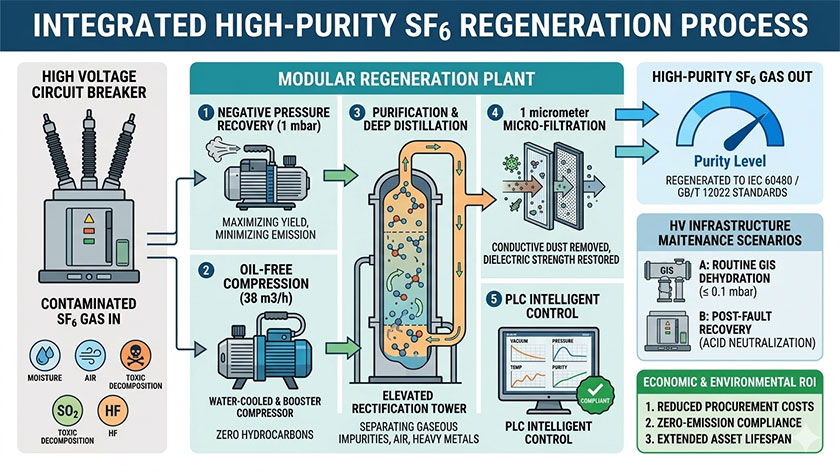
In the critical ecosystem of high-voltage (HV) infrastructure, Sulfur Hexafluoride (SF6) is the lifeline of insulation and arc suppression. However, as high-voltage circuit breakers undergo years of operational stress, the SF6 gas inevitably becomes contaminated with moisture, air, and toxic decomposition products like SO2 and HF.
Transitioning from simple gas recovery to high-purity SF6 regeneration is no longer just an environmental preference—it is a technical necessity to ensure the longevity of GIS (Gas Insulated Switchgear) assets and the safety of maintenance personnel.
1. The Critical Need for SF6 Regeneration in HV Maintenance
Standard maintenance often involves recovering gas into cylinders, but without proper regeneration, that gas remains a liability. Contaminated SF6 reduces the dielectric strength of the circuit breaker, leading to potential partial discharges or catastrophic equipment failure.
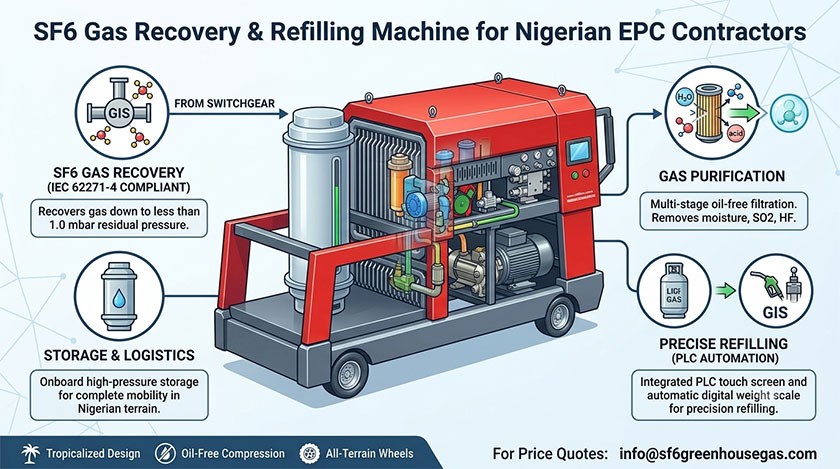
Our advanced SF6 gas recovery and purification device is engineered to transform "spent" gas back into high-purity insulating medium that meets or exceeds GB/T 12022 and IEC 60480 standards.
2. Technical Advantages: The Anatomy of High-Purity Regeneration
To achieve true regeneration, the maintenance equipment must move beyond basic filtration. Our system integrates three core technical advantages:
Elevated Rectification (Distillation): Unlike passive molecular sieves, our unit features an elevated rectification tower. This process leverages the different boiling points of SF6 and its impurities to perform deep purification, effectively separating complex heavy-metal fluorides and air.
1 micrometer Micro-Filtration Precision: Conductive metallic dust generated during arcing is often microscopic. Our system utilizes 1-micrometer (1um) high-precision filters to remove solid particulates, restoring the gas's dielectric integrity.
Oil-Free, Water-Cooled Compression: Using a 38 m3/h oil-free compressor, we ensure that no hydrocarbons are introduced into the gas stream during processing, a common flaw in lower-tier recovery units.
3. Core Technical Parameters
For procurement specialists, technical performance data is the ultimate benchmark of professionalism.
| Feature | Technical Specification |
| Recovery Strategy | Negative Pressure Recovery (Ultimate vacuum 1 mbar) |
| Compressor Capacity | 38 m3/h (Oil-free, Water-cooled) |
| Vacuum Pump Rate | 64 m3/h (Ultimate vacuum 0.1 mbar) |
| Filtration Accuracy | Less than or equal to 1 micrometer (1um) |
| Regeneration Quality | Compliant with GB/T 12022 / IEC 60480 |
| Filling Speed | 50kg in 5 to 8 minutes (40L cylinder) |
| Control System | Industrial PLC with high-resolution touchscreen |
4. Usage Scenario Analysis: HV Infrastructure Maintenance
Scenario A: Routine GIS Maintenance and Dehydration
During scheduled inspections, the device's 64 m3/h vacuum pump is used to deeply dehydrate the GIS chamber. Once a vacuum of 0.1 mbar or less is achieved, the regenerated, high-purity gas is refilled, ensuring a moisture-free environment for the circuit breaker contacts.
Scenario B: Post-Fault Gas Recovery
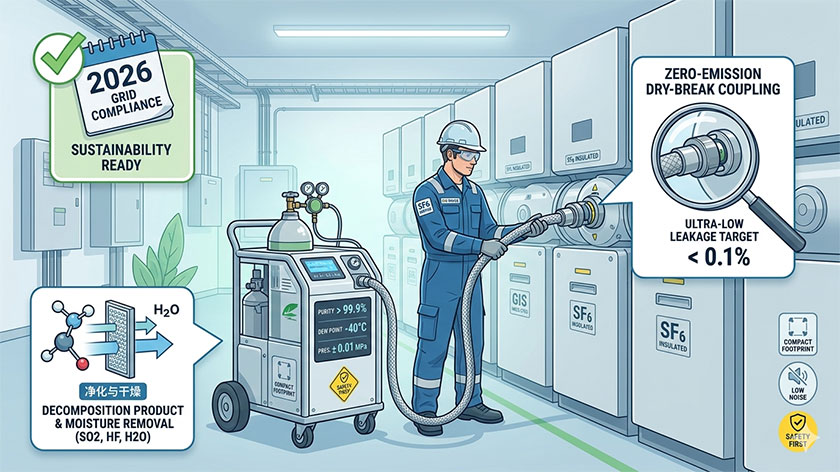
After an electrical fault, SF6 contains high concentrations of toxic SO2 and HF. The device’s chemical adsorption and rectification modules neutralize these acids and safely purify the gas, allowing it to be recycled rather than discarded as hazardous waste.
5. Economic and Environmental ROI
Implementing high-purity SF6 regeneration offers a clear return on investment:
Reduced Procurement Costs: Regenerating gas on-site reduces the need to purchase expensive "virgin" SF6.
Zero-Emission Compliance: By utilizing negative pressure recovery, utilities can capture 99.9% of the gas, meeting stringent F-gas regulations.
Asset Protection: High-purity gas prevents the corrosion of internal circuit breaker components, extending the maintenance interval of the HV infrastructure.
6. Conclusion
For modern high-voltage circuit breaker maintenance, the focus must shift toward High-purity SF6 regeneration for HV infrastructure. By integrating modular purification, oil-free compression, and intelligent PLC control, our device provides the professional rigor required to manage the world's most critical power grids.
Frequently Asked Questions: SF6 Regeneration and HV Maintenance
1. What is the difference between SF6 recovery and SF6 regeneration?
SF6 recovery refers to the simple extraction of gas from electrical equipment into a storage container. SF6 regeneration involves a multi-stage purification process—including oil-free compression, 1 micrometer filtration, and rectification—to remove moisture, toxic decomposition products (SO2, HF), and air. Regeneration restores the gas to a high-purity state (meeting IEC 60480 standards) so it can be safely reused in high-voltage infrastructure.
2. Why is oil-free compression critical for SF6 gas handling?
Standard compressors often use oil for lubrication, which can vaporize and contaminate the SF6 gas with hydrocarbons. This reduces the dielectric strength of the gas and can lead to equipment failure. An oil-free, water-cooled compressor ensures that no external contaminants are introduced during the recovery or regeneration cycle, maintaining the chemical integrity required for high-voltage circuit breakers.
3. How does moisture (micro-water) affect high-voltage circuit breakers?
High moisture levels in SF6 gas react with arcing products to form corrosive acids like hydrofluoric acid (HF). These acids can damage the internal components of the GIS (Gas Insulated Switchgear) and degrade the gas's insulation properties. Utilizing a regeneration device with a high-capacity purification tank and molecular sieves ensures that moisture is reduced to safe levels, typically below 150 ppmv for circuit breakers.
4. What is the role of an "Elevated Rectification Tower" in gas purification?
An Elevated Rectification Tower uses a distillation process to separate SF6 from impurities based on their differing boiling points. While standard filters only trap particles, rectification provides "deep purification" by separating gaseous impurities and complex heavy-metal fluorides. This is the most effective method for restoring highly contaminated SF6 gas to "near-new" quality.
5. Can SF6 gas be recovered under negative pressure?
Yes. Professional SF6 recovery units are equipped with a vacuum compressor capable of pulling gas down to a negative pressure (often as low as 1 mbar). This ensures that nearly 100% of the gas is captured from the HV equipment, preventing any residual "emission" into the atmosphere and maximizing the volume of gas available for regeneration.
Leave A Message
Your email address will not be published. Required fields are marked *
More Articles