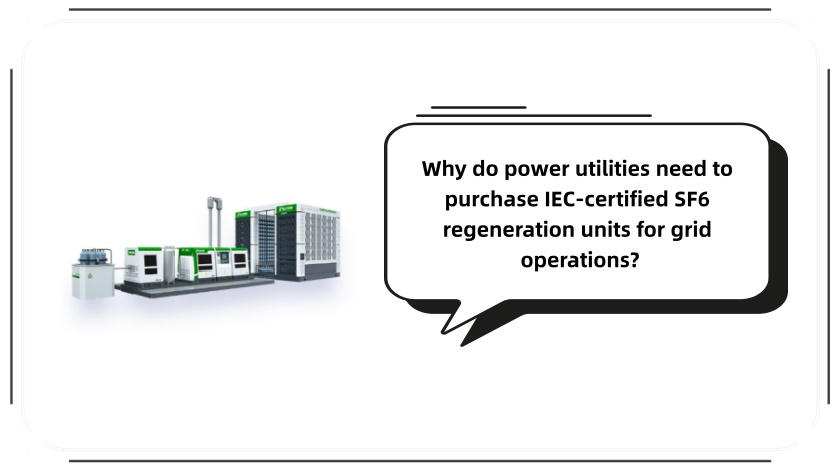
Why do power utilities need to purchase IEC-certified SF6 regeneration units for grid operations?
Power utilities are the backbone of modern energy systems, responsible for delivering stable electricity to millions of homes, businesses, and industries. To keep grids running safely, they rely heavily on sulfur hexafluoride (SF6)—a gas with unmatched dielectric strength and arc-quenching capabilities for high-voltage (HV) equipment like circuit breakers, transformers, and gas-insulated switchgear (GIS). Yet SF6’s extreme environmental impact—23,500 times the global warming potential (GWP) of CO₂ over 100 years—has made it a target of strict global regulations. For utilities, the solution isn’t just to reduce SF6 use, but to reuse it effectively. This is why Purchase IEC-certified SF6 regeneration units for power utilities has become a critical priority: these units ensure SF6 is purified to industry standards, cutting emissions, costs, and risks—all while keeping grids reliable.
Why Power Utilities Can’t Afford to Skip SF6 Regeneration (or IEC Certification)
Power utilities face unique pressures when it comes to SF6 management:
Massive SF6 usage: A single HV circuit breaker can hold 10–50kg of SF6, and a large substation may use hundreds of kilograms annually. Replacing this with new gas is costly (up to $100/kg) and environmentally damaging.
Tight regulatory scrutiny: Rules like the EU F-Gas Regulation, U.S. EPA SF6 Emission Reduction Program, and China’s "Double Carbon" goals mandate strict SF6 leak control, recovery, and reuse. Non-compliance leads to fines (up to €100,000 in the EU) and reputational damage.
Grid reliability stakes: Impure SF6 (contaminated with moisture, oil, or toxic byproducts) causes corrosion, insulation failure, and arc-quenching issues—leading to unplanned outages that cost utilities
10,000–50,000 per hour.
SF6 regeneration units solve the "reuse" problem by purifying used SF6 for reinsertion into equipment. But only IEC-certified units guarantee this purification meets the strict standards power utilities require. Without IEC certification, utilities risk:
Using gas that fails to meet performance benchmarks (e.g., too much moisture leading to breaker damage).
Voiding equipment warranties (many HV manufacturers require IEC-compliant gas for coverage).
Failing audits (regulators don’t recognize non-certified regeneration as valid for emissions reporting).
What IEC Certification Means for Power Utility SF6 Regeneration
IEC (International Electrotechnical Commission) sets global standards for electrical equipment and gas quality—two areas critical to utilities. For SF6 regeneration units, certification ties to two core standards:
1. IEC 60376: The Gold Standard for SF6 Purity
IEC 60376 defines the minimum quality of SF6 for use in electrical equipment, including:
Moisture limits: ≤50 ppm (parts per million) for regenerated gas (moisture above this causes metal corrosion and dielectric breakdown).
Impurity limits: ≤10 ppm for toxic byproducts (e.g., SO₂, HF) and ≤0.1% for non-condensable gases (e.g., N₂, O₂), which reduce arc-quenching efficiency.
IEC-certified regeneration units are rigorously tested to ensure they meet these limits—guaranteeing regenerated SF6 performs as well as new gas. For utilities, this means no compromise on grid safety.
2. IEC 60480: Safe, Low-Emission Regeneration
IEC 60480 governs SF6 handling throughout its lifecycle, with key requirements for regeneration units:
Emission control: Units must leak ≤0.1% of processed SF6 annually (preventing the very emissions utilities are trying to avoid).
Process safety: Units must include features like acid scrubbers and pressure relief valves to protect utility technicians from toxic exposure.
Certification ensures the unit aligns with these safety and environmental benchmarks—critical for utilities that prioritize worker safety and public trust.
4 Unmissable Benefits of IEC-Certified SF6 Regeneration Units for Utilities
For power utilities, investing in IEC-certified units isn’t just about compliance—it’s a strategic financial and operational choice:
1. Dramatic Cost Savings on SF6 Procurement
Regenerating SF6 costs 50–70% less than buying new gas. For example, a mid-sized utility using 500kg of SF6 yearly would spend 50,000onnewgas(at 100/kg). With an IEC-certified unit, regenerating 80% of that gas (40,000innewgasavoided)saves 30,000–35,000 annually.Over5years,that’s 150,000–175,000insavings—farexceedingtheunit’supfrontcost(20,000–$40,000).
2. Compliance with Global Regulations
IEC certification is universally recognized by regulators. A utility using certified units can easily prove compliance with local rules (e.g., EU F-Gas reporting, EPA leak audits) by providing certification documents and purification logs. This avoids costly fines and the administrative burden of defending non-certified processes.
3. Extended Lifespan of HV Equipment
Impure SF6 accelerates wear on circuit breakers and transformers—shortening their lifespan from 30 years to 20. IEC-certified units produce gas that meets IEC 60376 standards, preventing corrosion and dielectric damage. For utilities, this means delaying expensive equipment replacements (a single HV transformer costs 200,000–1 million) and reducing maintenance downtime.
4. Stronger ESG Credentials
Investors and customers increasingly prioritize utilities with low carbon footprints. IEC-certified SF6 regeneration reduces a utility’s carbon emissions (regenerating 1kg of SF6 avoids emissions equivalent to 23.5 tonnes of CO₂). A North American utility reported a 22% drop in SF6-related emissions within a year of adopting certified units—strengthening its ESG rating and attracting green energy investors.
What to Prioritize When Purchasing IEC-Certified SF6 Regeneration Units
To maximize value, utilities should focus on these key factors during purchase:
1. Verify IEC Certification Validity
Not all "IEC-compliant" claims are genuine. Check for:
An official IEC certification label (issued by an accredited testing body like UL or VDE).
Alignment with both IEC 60376 and 60480 (some units only meet one standard).
A valid certification date (certifications expire every 3–5 years, requiring re-testing).
2. Ensure Compatibility with Utility Equipment
Utilities use diverse HV gear (GIS, AIS, transformers). Choose a unit that:
Handles the SF6 volume your equipment requires (e.g., 5–50kg per batch for substations).
Connects to standard utility fittings (e.g., DN20/DIN flanges) to avoid adapter costs.
3. Prioritize Scalability and Portability
Large utilities with multiple substations benefit from:
Scalable units: Models that can process 10–100kg of SF6 to handle growth.
Portable designs: Compact units (≤100kg) that can be transported between substations (saving the cost of multiple fixed units).
4. Demand Robust After-Sales Support
Regeneration units require regular calibration to maintain IEC compliance. Look for suppliers that offer:
Annual calibration services (to keep purity and emission levels in check).
Local technical support (to minimize downtime if the unit malfunctions).
Training for utility staff (to ensure safe, correct operation).
Real-World Impact: A Utility Success Story
A European utility serving 2.5 million customers faced rising SF6 costs and EU F-Gas non-compliance. In 2022, it purchased 8 IEC-certified SF6 regeneration units for its 12 substations. By 2024:
It had regenerated 2,800kg of SF6 (75% of its annual usage), saving €140,000 on new gas.
SF6 emissions dropped by 68%, meeting EU F-Gas targets 2 years early.
HV equipment maintenance costs fell by 15% (no more corrosion-related breaker failures).
The utility’s CFO noted: "The IEC-certified units weren’t just an expense—they were a profit driver. The savings on gas and maintenance paid for the units in 18 months."
For power utilities, Purchase IEC-certified SF6 regeneration units is more than a procurement decision—it’s a commitment to sustainable, reliable, and cost-effective grid operations. These units solve the dual challenge of reducing SF6 emissions and controlling costs, all while meeting global regulations and protecting critical HV equipment. In an era where utilities are pressured to decarbonize and deliver reliable power, IEC-certified regeneration units are no longer optional—they’re essential.
Leave A Message
Your email address will not be published. Required fields are marked *
More Articles