How to Protect Operators from Toxic SF6 Decomposition Products: Must-Have Features for Your SF6 Gas Detector and SF6 Analyzer
Executive Summary: When SF6 gas in high-voltage switchgear is exposed to electrical arcing, it breaks down into highly toxic and corrosive decomposition products like sulfur dioxide (SO2) and hydrogen fluoride (HF). To protect maintenance personnel and comply with global safety standards, facilities must deploy high-precision monitoring tools. This guide outlines the critical safety features required in a modern SF6 gas detector (for leak detection and ambient monitoring) and a multi-function SF6 analyzer (for gas quality and byproduct testing), helping utility managers balance operator safety, environmental compliance, and cost efficiency.
The Invisible Threat: Toxic SF6 Decomposition Byproducts
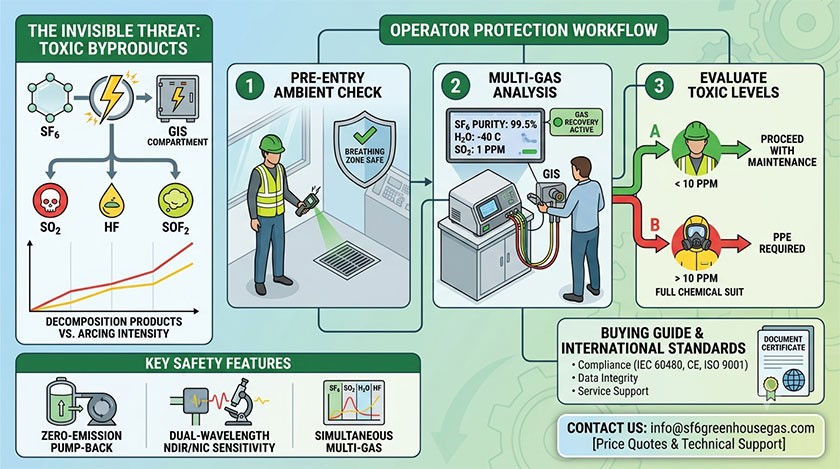
While pure sulfur hexafluoride (SF6) is a non-toxic, chemically stable insulating gas, high-energy events inside Gas-Insulated Switchgear (GIS)—such as partial discharges, sparking, or arcing—break its molecular bonds.
In the presence of trace moisture or oxygen, these fragments recombine to form dangerous byproducts, including:
Sulfur Dioxide (SO2): A highly irritating, pungent gas that serves as the primary indicator of internal equipment arcing.
Hydrogen Fluoride (HF): An extremely corrosive acid that attacks glass, metal, and human lung tissue.
Thionyl Fluoride (SOF2): A toxic gas that poses immediate respiratory hazards to maintenance crews.
To mitigate these risks during routine maintenance, gas recovery, or emergency troubleshooting, operators must rely on specialized monitoring equipment to detect leaks and analyze gas purity.
Must-Have Safety Features to Require in Your Equipment
When evaluating your next safety instrument purchase, look for these critical features to ensure maximum operator protection and regulatory compliance.
1. Zero-Emission Closed-Loop Testing (Pump-Back System)
In the past, testing gas purity meant venting small quantities of toxic decomposition gases directly into the atmosphere, exposing the operator. Modern industrial standards require your SF6 analyzer to feature an internal zero-emission pump-back system. This system automatically stores the sampled gas in an internal buffer tank and pumps it safely back into the electrical equipment or a recovery cylinder once the measurement is complete.
2. High-Sensitivity Ambient Leak Detection
Before a technician even steps into a basement or cable trench containing SF6 equipment, a portable SF6 gas detector should be used to scan the breathing zone. Look for detectors utilizing Non-Dispersive Infrared (NDIR) or Negative Ion Capture (NIC) technology. These sensors can pinpoint microscopic leaks down to 0.1 ppm without being thrown off by changes in ambient humidity or temperature.
3. Simultaneous Multi-Gas Measurement
To minimize exposure times, a field technician should only have to run a single test. Ensure your analysis equipment measures:
SF6 Purity (0-100%): To verify insulating capability.
SO2 Concentration (ppm): To determine the level of internal degradation and arcing.
Moisture / Dew Point: To verify that moisture levels will not trigger the formation of corrosive HF acid.
Equipment Selection: Detector vs. Analyzer
To help your procurement team select the correct asset-management tools, reference the technical specification standard below:
| Feature/Specification | Portable SF6 Gas Detector (Leak Sniffer) | Multi-Function SF6 Analyzer (Gas Quality) |
| Primary Safety Function | Pinpointing physical leaks & protecting breathing zones | Identifying toxic decomposition products inside GIS |
| Primary Target Gases | SF6 | SF6, SO2, H2O (Dew Point) |
| Sensor Technologies | Dual-wave Infrared (NDIR) / Ion Capture | Electrochemical (SO2), Chilled Mirror (H2O) |
| Optimal Sensitivity | Down to 0.1 ppm | SO2: 0.1 ppm resolution; SF6: +/- 0.5% accuracy |
| Emission Prevention | N/A (ambient air monitoring) | Built-in gas recovery compressor (zero-emission) |
| Compliance Standards | CE, IP54 ingress protection | IEC 60480, CIGRE guidelines, ISO 9001 |
Step-by-Step Operator Safety Workflow
Deploying a standardized testing sequence is essential to ensure that field technicians are never exposed to high concentrations of toxic acid gases:
1.1. Sniff the Outer Perimeter:Pre-entry ambient screening
Prior to starting work or entering enclosed spaces, use a portable SF6 gas detector to verify that ambient gas levels are safe and no oxygen-depleting leaks exist near the floor.
2.2. Establish Leak-Free Connections:Connecting to the gas compartment
Use self-sealing quick-connect couplings to link the multi-gas SF6 analyzer to the switchgear valve, preventing any accidental atmospheric release of toxic gas during hookup.
3.3. Execute the Multi-Gas Test:Automated analysis phase
Run the automated testing cycle. The SF6 gas analyzer will measure purity, moisture, and toxic SO2. Ensure the pump-back system captures the gas internally during this process.
4.4. Evaluate Toxic Levels:Post-test safety protocols
Check the SO2 reading. If the concentration exceeds 10 ppm, flag the compartment for heavy degradation. Ensure the operator wears full chemical respiratory protection before proceeding with any physical maintenance.
B2B Buying Guide: Resolving Industry Pain Points
Utility managers and international procurement officers face unique challenges when purchasing gas handling safety equipment:
Navigating Strict Environmental Compliance: With global regulations tightening around greenhouse gas emissions, choosing an SF6 analyzer with certified leak-free connections and pump-back capabilities ensures compliance with local environmental protection agencies.
Minimizing Operational Downtime: Look for instruments featuring self-calibration technology and modular "plug-and-play" sensor replacement. This prevents long shipping delays for yearly factory calibrations and maximizes tool availability.
Ensuring High Data Integrity: For reliable asset-risk assessment, purchase equipment that provides documented calibration certificates traceable to international standards (such as ISO/IEC 17025).
Frequently Asked Questions
What level of SO2 is considered dangerous for operators?
In operational environments, any concentration of SO2 over 1-2 ppm indicates that SF6 decomposition has begun. Levels above 10 ppm are highly toxic and require specialized protective breathing apparatus and chemical resistant PPE before opening the gas compartment.
Can a single device act as both a detector and an analyzer?
Generally, no. A handheld SF6 gas detector is optimized as an open-air sniffing tool to trace microscopic leaks at joint connections. Conversely, an SF6 analyzer is a closed-loop scientific instrument designed to measure precise chemical composition, moisture, and byproducts directly from a pressurized gas volume.
How often should safety sensors be calibrated?
To guarantee operator safety and data accuracy, electrochemical sensors inside analyzers should be calibrated every 12 to 24 months, depending on usage frequency and exposure to high acid-gas concentrations.
Need Expert Assistance or a Custom Quote?
Choosing the correct safety equipment depends on your specific switchgear setup, regional regulations, and budget constraints. For customized technical advice, equipment specifications, or a competitive price quote on an industry-compliant SF6 gas detector or SF6 analyzer, reach out to our technical support team directly at
Leave A Message
Your email address will not be published. Required fields are marked *
More Articles