Do SF6 Recovery and Refilling Units Need Professional Installation? What Training Is Provided?
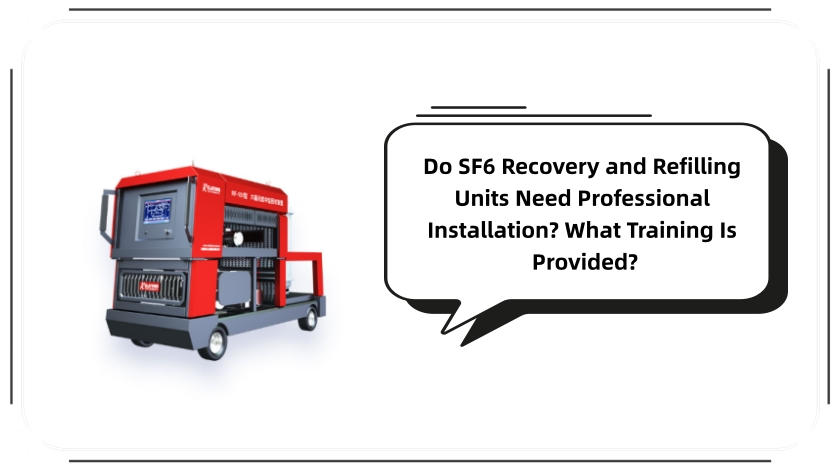
Sulfur hexafluoride (SF6) is a potent greenhouse gas used widely in high-voltage electrical equipment. Due to its extreme global warming potential (GWP of 23,500), strict regulations—such as the EU F-Gas Regulation (No 517/2014) and EPA guidelines—govern its handling. This raises a critical question for utilities and industrial operators: Do SF6 gas recovery and refilling machines require professional installation, and do suppliers provide training? The short answer: Yes—and yes.
Why Professional Installation Is Essential
SF6 handling equipment isn’t plug-and-play in practice. While some portable units appear simple, professional installation ensures safety, compliance, and performance.
Safety First: SF6 is stored under high pressure and can displace oxygen in confined spaces. Incorrect setup risks leaks or exposure.
Regulatory Compliance: In the EU, only F-Gas-certified companies and technicians may legally install or service SF6 systems. Even in regions with looser rules (e.g., parts of the U.S.), best practices demand certified personnel.
System Integrity: Proper installation includes leak testing, vacuum integrity checks, and calibration of mass flow meters and scales—vital for accurate gas accounting required by law.
Equipment Longevity: Correct hose routing, filter alignment, and power integration prevent premature wear or failure.
Expert Insight: From field experience across European transmission networks, units installed without certified oversight often fail first-year leak audits—triggering fines under F-Gas reporting rules.
What Does Installation Typically Include?
A standard professional commissioning covers:
Secure mounting (mobile cart or fixed station)
Connection to recovery/refill manifolds
Vacuum pump and compressor validation
Calibration of integrated scales and purity analyzers
Digital system setup (for audit-ready data logging)
Even “ready-to-use” units benefit from on-site verification by a qualified technician before first operation.
Supplier Training: Standard Practice for Reputable Brands
Top-tier SF6 equipment suppliers routinely include comprehensive training—because they understand that user competence directly impacts environmental compliance and brand reputation.
Typical Training Components:
Hands-on Operation: Safe recovery, purification, storage, and refilling procedures.
Maintenance Protocols: Filter changes, oil replacement, and leak diagnostics.
Compliance Logging: How to generate digital records meeting F-Gas Article 10 requirements (quantity recovered, operator ID, timestamps).
Emergency Response: Handling accidental releases, PPE use, and ventilation protocols.
Software Navigation: Using onboard diagnostics or cloud-based fleet management tools.
Training formats vary:
On-site (most effective for teams)
Remote/virtual (via video demo + Q&A)
E-learning modules with certification quizzes
Authority Note: Leading manufacturers often partner with accreditation bodies to align training with national F-Gas certification schemes.
Regulatory Context: Why This Matters
European Union: F-Gas Regulation mandates that only certified personnel handle SF6. Companies must also maintain detailed logs of all gas transactions. Improper installation or untrained use = non-compliance.
United States: While federal rules under EPA Section 608 focus more on refrigerants, many states and utilities enforce internal SF6 management programs requiring documented training and leak prevention.
Global Trend: ISO 14064 and GHG Protocol frameworks increasingly require auditable SF6 tracking—making trained operators and properly installed equipment essential.
Key Questions to Ask Suppliers Before Buying
To ensure E-E-A-T (Experience, Expertise, Authoritativeness, Trustworthiness) alignment:
Is initial installation support included? (On-site or remote guidance?)
Is hands-on training provided—and is it tailored to local regulations?
Do you supply calibration certificates and CE/UKCA conformity documentation?
Can your system export data in formats accepted by environmental regulators?
Choosing a supplier that answers “yes” builds trust and reduces compliance risk.
Conclusion: Invest in Proper Setup and Training
SF6 recovery and refilling units are not just tools—they’re compliance gateways. Professional installation ensures technical reliability and legal adherence, while supplier-led training empowers your team to operate safely and accountably.
Given SF6's extreme climate impact and tightening global regulations, cutting corners on installation or training is neither safe nor cost-effective. Partner with manufacturers who demonstrate real-world expertise, provide authoritative documentation, and stand behind their equipment with credible, regulation-aligned support.
By doing so, you protect your workforce, your assets, and the environment—while staying audit-ready in an era of increasing climate accountability.
Leave A Message
Your email address will not be published. Required fields are marked *
More Articles