SF6 Gas Recovery in GIS Maintenance: Regulations & Equipment Guide
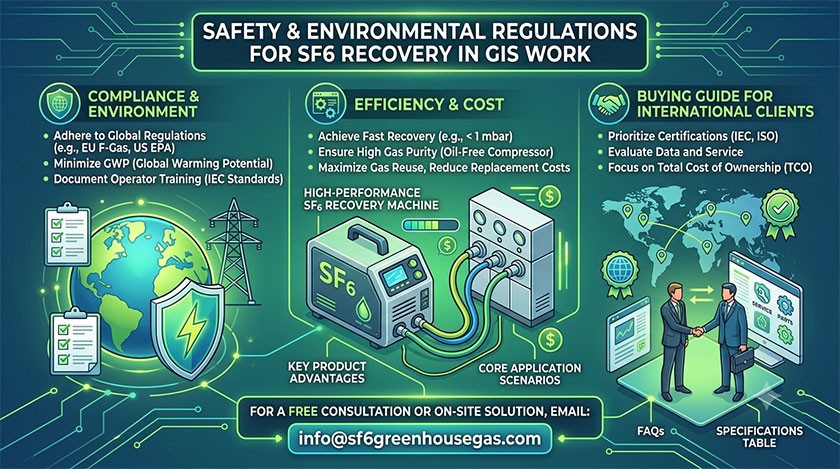
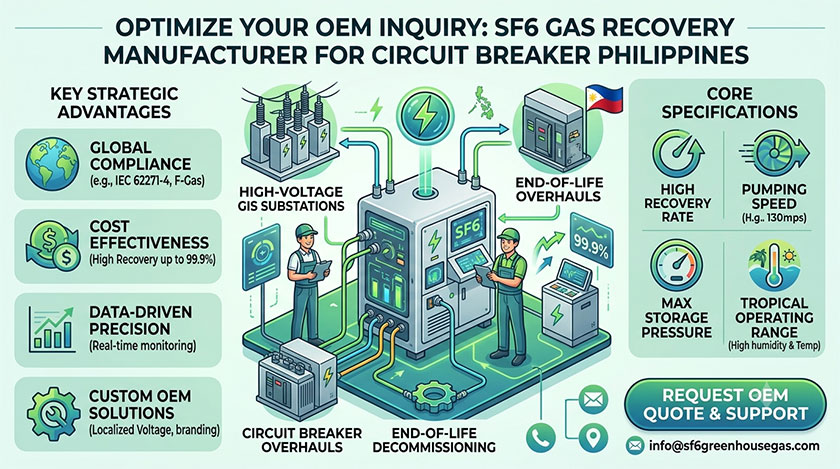
In modern high-voltage electrical substations, Gas-Insulated Switchgear (GIS) relies heavily on Sulfur Hexafluoride (SF6) due to its exceptional dielectric insulation and arc-extinguishing performance. However, because SF6 has a Global Warming Potential (GWP) 24,300 times greater than CO2, international environmental legislation strictly prohibits fugitive emissions and improper venting during routine servicing, commissioning, or decommissioning.
For grid operators, substation engineering teams, and power maintenance contractors, managing insulating gas involves balancing regulatory compliance, gas procurement costs, and operational downtime. Deploying an enterprise-grade SF6 gas recovery machine provides a reliable solution to these challenges, ensuring high gas purity, zero atmospheric discharge, and full auditability.
Need technical advice for your substation? If you are evaluating equipment configurations for high-voltage maintenance, contact our engineering team at [email protected] for a free technical consultation and customized machine sizing.
1. Regulatory Framework Governing SF6 Gas Recovery
To mitigate greenhouse gas emissions, global regulatory bodies enforce strict protocols regarding the handling, tracking, and recycling of industrial SF6 gas:
IEC 62271-4 & IEC 60480 Standards: Mandate closed-loop gas transfer practices, strict moisture and purity limits for gas reuse, and certified technician procedures.
EU F-Gas Regulation (2024/573): Enforces mandatory leak monitoring, complete prohibition of intentional venting, and detailed digital recording of all recovered and recharged gas volumes (in kg and CO2 equivalents).
US EPA & ISO 14064 Frameworks: Require comprehensive reporting of direct Scope 1 greenhouse gas emissions for utility providers and industrial facilities.
Adopting fully compliant SF6 gas recovery procedures mitigates the risk of financial penalties, protects field personnel from toxic decomposition byproducts, and aligns grid operations with international environmental targets.
2. Core Technological Advantages of Modern SF6 Recovery Systems
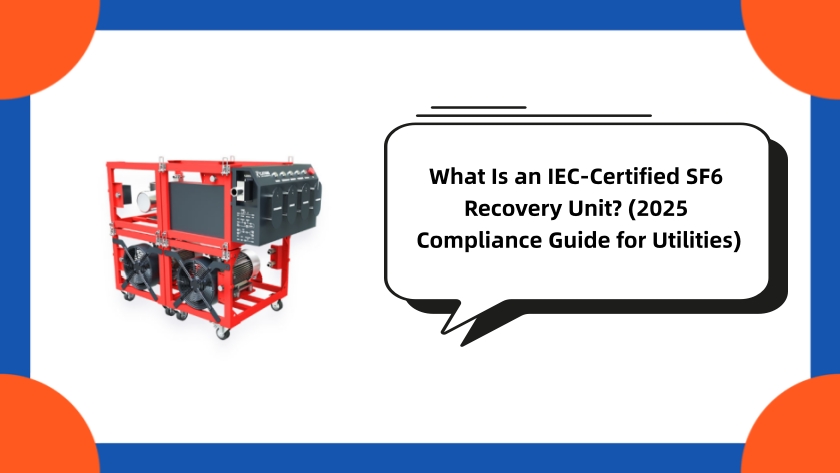
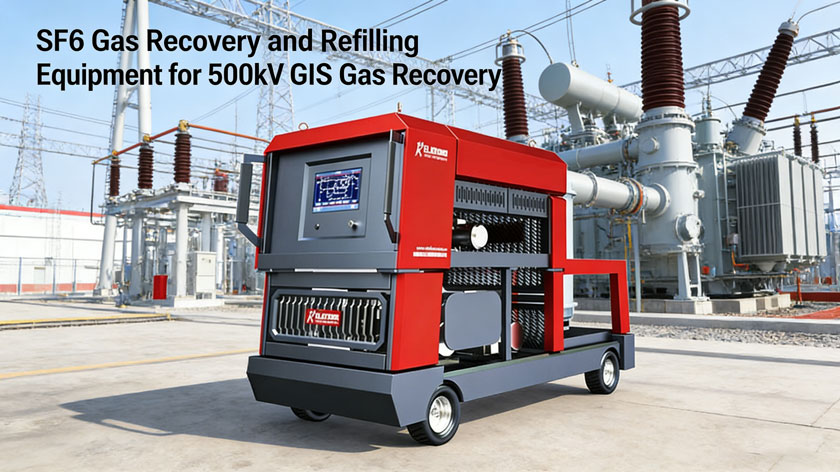
Industrial-grade SF6 gas recovery machines integrate high-pressure evacuation, multi-stage filtration, and automated gas liquefaction into a mobile cart architecture.
Zero-Leakage Oil-Free Compression
Direct-Drive Oil-Less Compressors: Eliminates oil vapor contamination of the SF6 gas supply while maintaining compression ratios up to 1000:1 for rapid liquefaction and storage.
Hermetic Self-Sealing Valves (DN8 / DN20): Quick-connect safety couplings prevent residual gas leakage during hose coupling and uncoupling.
Advanced Purification and Deep Vacuum Recovery
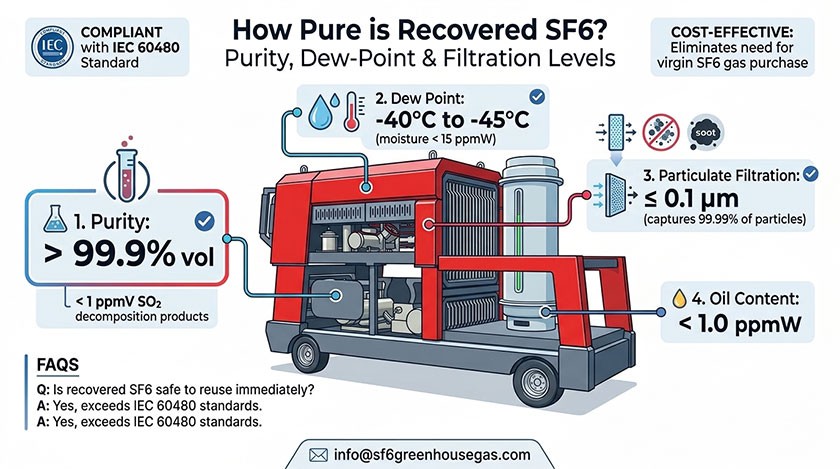
Multi-Stage Filtration (Down to 0.1 µm): Internal desiccant and particulate filters remove moisture, oil traces, and corrosive breakdown products (such as SOF2 and SO2) to restore gas purity up to 99.9%.
Deep Vacuum Evacuation (< 1 mbar): Pulls residual gas from GIS compartments down to less than 1 mbar, ensuring maximum recovery efficiency before opening compartments for inspection.
Intelligent Process Control & Data Logging
Automated Touchscreen Interface: Microprocessor-controlled recovery, evacuation, and refilling cycles reduce operator error and minimize maintenance downtime.
Integrated Gas Quality Analysis: Real-time monitoring of gas dew point (down to -60°C) and purity percentage simplifies audit logging for environmental reporting.
3. Standard Technical Specifications
The table below outlines baseline performance metrics for enterprise-grade SF6 gas recovery equipment deployed across medium-, high-, and ultra-high-voltage switchgear installations:
| System Parameter | Baseline Performance Standard | Operational Impact |
| Gas Recovery Rate | Up to 30 lbs/hr (13.6 kg/hr) | Minimizes total substation downtime during maintenance |
| Final Vacuum Level | < 1 mbar (< 0.75 Torr) | Exceeds IEC guidelines for residual gas extraction |
| Compressor Architecture | 100% Oil-Free, Direct-Drive | Guarantees zero oil contamination of recovered gas |
| Moisture / Purity Monitoring | Digital dew point down to -60°C | Enables immediate on-site verification per IEC 60480 |
| Particle Filtration | 0.1 micron inline filter | Removes fine solid decomposition particulates |
| Storage Capacity | Onboard liquid cylinder + external tank port | Flexible storage options for small or bulk GIS compartments |
| Interface Connections | Flame-resistant DN8 / DN20 self-sealing | Eliminates fugitive releases during fluid transfers |
Request a tailored quote: Have specific pressure or recovery throughput requirements? Send your switchgear volume and voltage specifications to [email protected] to receive a detailed system proposal and customized quotation.
4. Key Application Scenarios in GIS Operations
                   GIS Life Cycle Management
                               │
      ┌──────────────────┬─────┴───────┬──────────────────┐
      ▼                  ▼             ▼                  ▼
Substation          Routine       Emergency          End-of-Life
Commissioning       Maintenance   Repair             Decommissioning
Substation Commissioning: Deep vacuum evacuation of new switchgear enclosures (< 1 mbar) to eliminate ambient air and moisture prior to filling with virgin or recycled SF6 gas.
Preventive Maintenance: Scheduled gas extraction, inline purification, moisture drying, and re-pressurization to preserve dielectric strength and prevent internal arcing.
Emergency Repair Work: Rapid gas evacuation into auxiliary storage tanks, allowing technicians to perform safe physical repairs on damaged breaker chambers.
Decommissioning & Reclamation: Final extraction and gas consolidation into transport cylinders for off-site re-refining or high-temperature thermal destruction.
5. Engineering Buyer's Guide for Overseas Procurement
International utility buyers and EPC contractors evaluating SF6 gas recovery machines should focus on three foundational selection criteria:
Regulatory Certifications: Ensure third-party verification for IEC 62271-4 compliance, CE certification, ASME/PED pressure vessel compliance, and ISO 9001 manufacturing quality standards.
Total Cost of Ownership (TCO): High recovery rates (> 99.5%) reduce the need to purchase costly virgin replacement gas. Evaluate long-term filter element replacement costs and compressor service intervals.
After-Sales Engineering Support: Verify that the equipment manufacturer provides global spare parts delivery, operator training programs, and annual sensor calibration support.
Plan your next project: For personalized engineering guidance, customized skid designs, or on-site commissioning support, reach out directly to our technical sales team at [email protected].
6. Frequently Asked Questions (FAQs)
Q1: Why is an oil-free compressor required in an SF6 gas recovery machine?
A: Standard lubricated compressors introduce oil mist into the gas stream, degrading the dielectric strength of the SF6 gas and requiring expensive secondary filtration. Oil-free compressors preserve original gas quality and ensure safe re-injection into high-voltage switchgear.
Q2: What gas quality standards must be met before re-using SF6 in GIS?
A: According to IEC 60480, reclaimed SF6 gas intended for reuse must achieve a purity level of at least 97%, maintain a dew point below -36°C, and contain minimal total acidity and particulate contamination.
Q3: How frequently should inline desiccant and particulate filters be serviced?
A: Inline filters should be inspected annually or after processing designated gas volumes (e.g., 500 kg of gas). Immediate filter replacement is required when recovering gas from switchgear compartments affected by internal arc faults due to heavy decomposition byproducts.
Leave A Message
Your email address will not be published. Required fields are marked *
More Articles