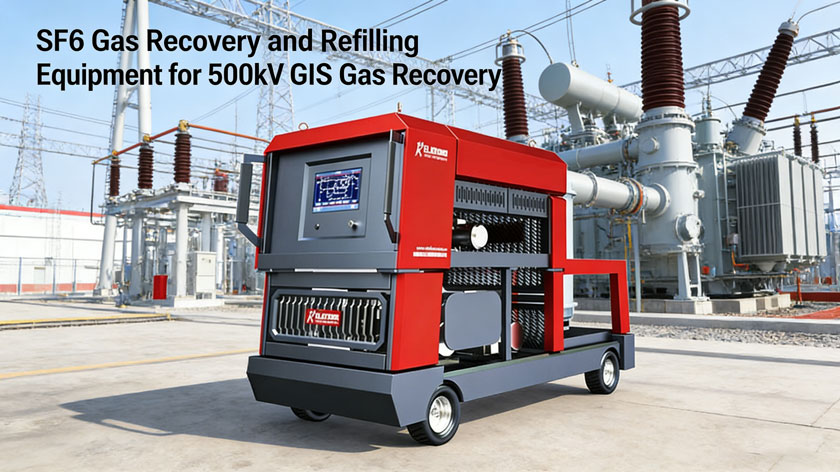
SF6 Gas Recovery and Refilling Equipment for 500kV GIS Gas Recovery
In the landscape of modern high-voltage power transmission, the stability of the 500kV grid serves as the ultimate benchmark for national energy security. Central to this infrastructure is Gas Insulated Switchgear (GIS) and porcelain column circuit breakers, which rely on Sulfur Hexafluoride (SF6) for its unparalleled insulating and arc-quenching properties. However, the operational management of SF6—a potent greenhouse gas—demands a level of technical rigor that balances grid reliability with environmental stewardship.
As utilities move toward more sustainable maintenance cycles, the deployment of specialized SF6 gas recovery and refilling equipment for 500kV GIS gas recovery has become a critical requirement. This article explores the technical imperatives, structural advantages, and compliance standards of high-performance recovery units, illustrating why professional-grade gas treatment is the cornerstone of 500kV substation maintenance.
1. The Strategic Importance of 500kV GIS Gas Management
A 500kV GIS substation represents a massive investment in infrastructure and holds significantly higher volumes of SF6 gas compared to 110kV or 220kV systems. During major overhauls, equipment upgrades, or emergency repairs, the gas must be handled with a "zero-leakage" philosophy.
Environmental and Regulatory Compliance
SF6 is regulated under strict international and local standards (such as DL/T 662) due to its high Global Warming Potential (GWP). Using an SF6 gas recovery and refilling equipment for 500kV GIS gas recovery ensures that utilities comply with carbon emission reduction targets. By recovering and regenerating gas on-site, the industry reduces the need for virgin gas production, effectively closing the loop in a circular economy.
Operational Safety and Equipment Lifespan
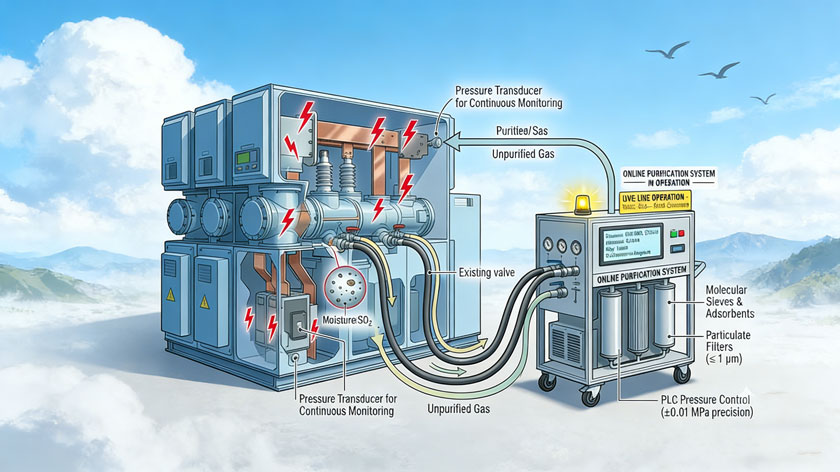
The purity of SF6 gas directly dictates the dielectric strength of the switchgear. Over time, moisture ingress and arcing byproducts (such as SO2 and HF) can compromise the internal insulation. High-performance recovery equipment does more than move gas; it purifies the medium, removing harmful contaminants that would otherwise accelerate the aging of 500kV assets.
2. Technical Innovations in High-Capacity Recovery Units
For the demanding task of 500kV gas recovery, equipment must be engineered for both speed and precision. High-performance devices exemplify this balance through a series of integrated technical innovations.
Oil-Free Compression Technology
One of the greatest risks in gas handling is cross-contamination. Traditional compressors may introduce oil vapor into the SF6 stream, which coats the internal insulation of the GIS and can lead to catastrophic failure under high-voltage stress. Modern equipment utilizes an oil-free water-cooled compressor (15 cubic meters per hour) and an oil-free booster (5 cubic meters per hour). This ensures that the gas remains chemically pure throughout the recovery and refilling cycles.
Negative Pressure Recovery System
In a 500kV GIS bay, even a tiny amount of residual gas can represent a significant volume. The integrated negative pressure recovery technology allows the equipment to pull gas well below atmospheric pressure. This maximizes the recovery rate, ensuring that the "dead volume" in the circuit breaker is minimized before the system is opened for mechanical maintenance.
Advanced Multi-Stage Filtration
The purification module is designed to capture contaminants at a microscopic level. With a filtration particle size of 1 micron or less, the system effectively traps solid particles, moisture, and acidic decomposition products. This level of filtration is essential for 500kV systems, where even minor impurities can cause partial discharge at high field strengths.
3. Core Technical Parameters: A Standard of Rigor
To understand the capability of an SF6 gas recovery and refilling equipment for 500kV GIS gas recovery, one must examine the rigorous parameters required for large-scale operations:
| Parameter Name | Specification | Operational Benefit |
| Recovery Rate | 15 m3/h (Oil-free) | Rapid processing for large GIS bays |
| Oil-free Booster | 5 m3/h @ liquid SF6 | Facilitates high-density storage |
| Final Output Pressure | 50 bar | High-pressure cylinder filling |
| Filtration Accuracy | 1 micron or less | Ensures high dielectric gas purity |
| Vaporizer Power | 1.5 kW | High-speed gas refilling without freezing |
| Liquid Filling Speed | 50kg in 5-8 minutes | Efficient logistics for 40L cylinders |
4. Efficiency in Field Operations: Refilling and Vaporization
While recovery is about safety, refilling is about efficiency. The window for substation maintenance is often measured in hours, not days.
High-Speed Vaporization and Output
During refilling, SF6 gas can drop in temperature due to rapid expansion, leading to the freezing of valves and slow gas flow. Professional equipment is equipped with a 1.5 kW vaporizer and a gas heating system. This allows for a pressure-regulated output of 1 to 10 bar, enabling technicians to refill large 500kV chambers to their rated density in record time.
Intelligent Monitoring and PLC Control
Modern 500kV operations demand real-time data. Integrated PLC systems provide a digital interface where vacuum changes, pressures, and temperatures are displayed instantly. This removes human error from the equation, allowing for precise control over the vacuum-pumping phase and ensuring that no moisture remains in the GIS before the SF6 is reintroduced.
5. Global Adaptability: From High Heat to Severe Cold
Substations are often located in extreme environments, from high-altitude plateaus to humid coastal regions. The equipment must be adaptable.
Auxiliary Recovery and Cooling
The auxiliary cooling type (often water-cooled) ensures that the compression process remains stable even in high ambient temperatures. This prevents the compressor from overheating and maintains a consistent recovery speed. Furthermore, modular designs and semi-enclosed protective structures allow for easy transport and deployment in complex substation layouts.
6. Practical Scenarios: Compliance Testing and Overhaul
The application of this equipment follows a rigorous three-step protocol during a 500kV GIS overhaul:
Vacuuming and Leak Detection: Before gas is introduced or after the chamber is opened, the vacuum pump evacuates air and moisture. The anti-oil-return valve ensures the GIS remains uncontaminated.
Recovery and Purification: The gas is drawn out of the switchgear, passed through the 1-micron filter, and stored in a liquid state at up to 50 bar in cylinders.
Regeneration and Refilling: Once repairs are complete, the purified gas is heated, vaporized, and refilled back into the bay, restoring the system to peak insulating capacity.
7. Conclusion: Investing in a Sustainable Power Future
The maintenance of 500kV GIS is a task that allows for no margin of error. The deployment of professional SF6 gas recovery and refilling equipment for 500kV GIS gas recovery is a strategic investment that pays dividends in both operational reliability and environmental compliance.
By integrating oil-free compression, negative pressure recovery, and high-efficiency vaporization, modern recovery units set a new standard for substation management. As we transition toward a greener and more resilient grid, the ability to recover, purify, and reuse SF6 gas with zero pollution is not just a technical advantage—it is a professional responsibility to the planet and the power industry.
Leave A Message
Your email address will not be published. Required fields are marked *
More Articles