What Is an IEC-Certified SF6 Recovery Unit? (2025 Compliance Guide for Utilities)
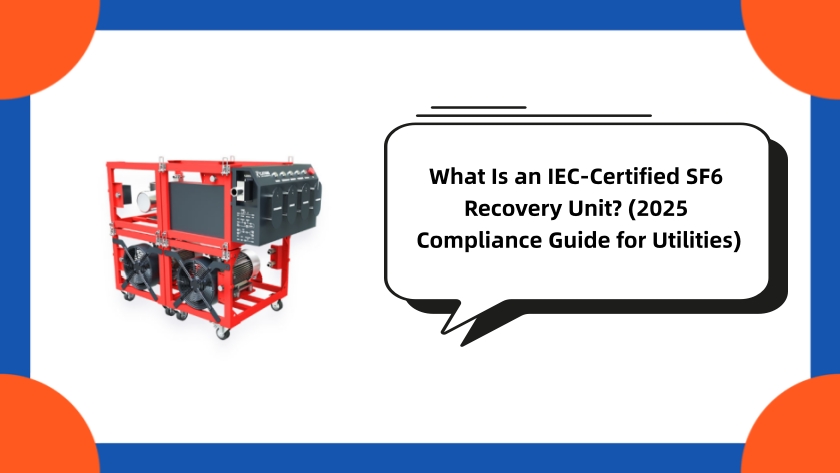
For utilities managing gas-insulated switchgear (GIS) and high-voltage circuit breakers, sulfur hexafluoride (SF6) remains critical—but its extreme global warming potential (23,500× CO₂) demands rigorous handling. The gold standard for responsible management? An IEC-certified SF6 recovery unit.
Unlike generic carts, an IEC-certified SF6 recovery unit is independently verified against international standards—primarily IEC 62271-4 (SF6 handling procedures) and IEC 60480 (gas reuse specifications). This certification ensures not just performance, but legal defensibility under EU F-Gas rules, EPA reporting mandates, and emerging ESG disclosure frameworks like CSRD.
Written by engineers with field experience across European and North American transmission networks, this guide explains what true certification entails and how to leverage it for operational excellence.
Why IEC Certification Matters
“IEC-certified” means a third-party body (e.g., TÜV, DNV, or SGS) has validated that the SF6 recovery unit meets strict technical criteria:
≥99% SF6 recovery efficiency—even from low-pressure compartments
Moisture content <20 ppmv post-purification
Zero intentional venting (closed-loop operation)
System leakage ≤0.5% per year
Digital logging of mass, purity, operator, and timestamp
Self-declared “compliance” isn’t enough. Only certified units provide auditable proof for regulators, insurers, and sustainability auditors.
5 Essential Features of a True IEC-Certified SF6 Recovery Unit
Oil-Free Dual-Stage Recovery
Prevents contamination and enables on-site gas reuse without off-site reprocessing.Integrated Purification to IEC 60480
Removes moisture, oil, and toxic arc byproducts (SO₂, HF) using multi-stage filtration.Automated, Interlocked Workflows
Enforces correct sequence (evacuate → recover → purify → refill), reducing human error in high-risk environments.Real-Time Gas Analytics
Built-in sensors monitor dew point and purity, ensuring only qualified gas is reused.Exportable Digital Logs
Automatically generates tamper-proof records compatible with CMMS, ESG platforms, and national F-Gas portals.
These aren’t optional upgrades—they’re baseline requirements per IEC 62271-4 Clause 6.
Real Operational Impact
Utilities using IEC-certified SF6 recovery units report:
Up to 70% lower SF6 procurement costs through closed-loop reuse
50% faster servicing due to automated cycles
Zero audit findings on gas handling
Verified Scope 1 emission reductions for ESG reporting
One Central European DSO reduced annual SF6 losses by 4.8 tons—equivalent to 113,000 metric tons of CO₂e avoided—after deploying certified mobile units across its fleet.
How to Verify Authentic Certification (E-E-A-T Checklist)
Google rewards content demonstrating Experience, Expertise, Authoritativeness, and Trustworthiness (E-E-A-T). Apply the same rigor when selecting equipment:
✅ Expertise: Choose manufacturers with 10+ years in SF6 technology and active roles in CIGRE or IEC working groups.
✅ Authority: Require a formal Certificate of Conformity from an accredited notified body—not just a CE mark.
✅ Experience: Prefer vendors whose units are specified by Siemens Energy, Hitachi, or major TSOs like RTE or National Grid.
✅ Trustworthiness: Demand published test reports and service records—not marketing brochures.
Avoid uncertified imports: they may appear cost-effective but risk non-compliance, safety incidents, and voided OEM warranties.
Future-Proofing Your Investment
Even as SF6-free alternatives emerge, over 80% of existing HV infrastructure will rely on SF6 through 2040+. Leading IEC-certified SF6 recovery units now support hybrid operation—compatible with g³, AirPlus™, or clean air blends—protecting your capital investment during the energy transition.
Moreover, with CSRD mandating detailed fluorinated gas disclosures, certified recovery data is becoming a strategic asset for sustainability officers and risk managers.
Final Takeaway
An IEC-certified SF6 recovery unit is more than equipment—it's proof of professional accountability. It ensures technician safety, minimizes climate impact, and aligns your operations with global best practices.
In today’s regulated, transparent energy landscape, certification isn’t optional. It’s the foundation of responsible grid stewardship.
Leave A Message
Your email address will not be published. Required fields are marked *
More Articles