Mobile SF6 Recovery Unit Power Guide: Can It Run on a Generator or Battery On-Site?
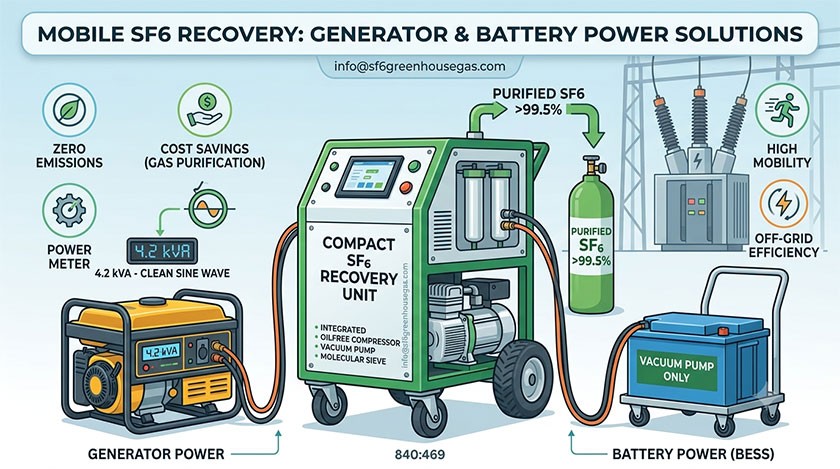
Substation maintenance teams can successfully power a mobile SF6 recovery unit on-site using a portable generator or an industrial battery energy storage system (BESS), provided the power source is correctly rated to handle the compressor's high startup inductive current. While standard inverter generators with low total harmonic distortion (THD) are the industry standard for reliable field operations, battery power serves as an eco-friendly alternative for smaller vacuuming and top-off tasks. Matching your mobile SF6 gas recovery cart to the right off-grid power supply ensures uninterrupted field maintenance, zero-emission environmental compliance, and massive cost savings through on-site gas purification.
Below, we break down the engineering reality of off-grid sulfur hexafluoride gas handling, outlining exact generator sizing formulas, battery limits, and practical tips to ensure your field crew remains fully compliant and highly efficient.
If you require direct assistance with technical configurations, customized engineering diagrams, or pricing inquiries, reach out to our global support team at [email protected] for a rapid, expert response.
Technical Specifications: Power & Performance
To help you match your on-site power source to the appropriate recovery equipment, review the structured comparison of standard mobile SF6 systems below:
| System Type | Typical Storage Capacity | Vacuum Pump Power | Compressor Motor | Min. Generator Requirement | Best Power Source |
| Micro-Cart (Mini) | Cylinder-based | 0.37 kW | 0.24 kW | 3.5 kVA or greater (Single-Phase) | Portable Generator or Industrial Battery Pack |
| Medium Mobile Trolley | 30 to 50 kg | 1.5 kW | 1.5 to 5.5 kW | 8 to 12 kVA or greater (Split/3-Phase) | Medium Generator |
| Heavy-Duty GIS System | 100 to 300 kg | 2.2 to 5.5 kW | 5.5 to 11 kW | 25 to 40 kVA or greater (3-Phase) | Tow-Behind Generator Trailer |
1. Portable Generator Power: The Technical Realities
Using a portable generator is the most common approach for powering a mobile SF6 recovery cart in remote substations. However, running heavy inductive loads like oil-free SF6 compressors requires specific engineering precautions.
The Surge Current Factor: AC motors in SF6 compressor units demand 3 to 5 times their running current during startup. For example, a 1.5 kW compressor may momentarily pull over 5 kW of power when starting against high backpressure.
Total Harmonic Distortion (THD): Modern SF6 gas recovery units utilize digital PLC touchscreens, electromagnetic sensors, and automated safety valves. Standard construction-grade generators can produce "dirty" power with high THD, which can burn out sensitive control boards.
The Inverter Solution: Always run digital SF6 gas handling carts on clean-sine-wave inverter generators or generators with an Automatic Voltage Regulator (AVR) keeping THD under 5%.
2. On-Site Battery Power: Is It Feasible?
With global utilities pushing toward carbon-neutral operations, battery-powered SF6 gas recovery is gaining traction. While fully replacing a generator with batteries is challenging, it is practical under certain conditions:
Substation Vacuuming & Evacuation: Evacuating air and moisture from a gas-insulated switchgear (GIS) chamber using a low-power vacuum pump (0.37 to 0.75 kW) can easily be run off modern portable lithium-ion power stations (BESS) for several hours.
The Liquefaction Constraint: Liquefying SF6 gas for high-pressure storage requires high continuous energy. Direct battery operation for large thermal or mechanical liquefaction systems is generally restricted to hybrid trailers that utilize a battery bank backed up by a solar array or a small range-extending generator.
3. Solving the 3 Major Industry Pain Points
Investing in a versatile, field-ready mobile SF6 recovery unit resolves critical operational and financial bottlenecks for utilities and substation contractors:
I. Environmental Compliance (Zero Leakage)
SF6 is the world’s most potent greenhouse gas, regulated strictly by the US EPA and EU F-Gas mandates. Our systems utilize heavy-duty, closed-loop configurations to achieve 99.9% gas recovery rates, ensuring that even when running on generator power, zero gas escapes to the atmosphere.
II. Drastic Cost Savings (Gas Reclamation)
Replacing contaminated SF6 is expensive and heavily taxed. By utilizing on-site power to run the integrated drying and purification filters (featuring advanced molecular sieves), your team can purify degraded gas back to IEC 62271-4 purity standards (97% to 99.5% or greater) directly in the field, entirely removing off-site processing costs.
III. Maximizing Substation Efficiency
Waiting for local grid permissions or hauling massive extension cabling wastes precious outage windows. A highly maneuverable mobile SF6 recovery trolley paired with a compact portable generator allows technicians to start gas recovery within minutes of arriving on-site.
4. Key Field Application Scenarios
Remote Transmission Line Substations: Where local auxiliary power is unavailable or deactivated during high-voltage equipment maintenance.
Onshore & Offshore Wind Farms: Where compact footprints are required, and the gas-handling cart must run reliably on the turbine platform's local generator hookup.
Rapid-Response Leak Containment: Emergency deployment scenarios where rapid gas evacuation from a failing circuit breaker is necessary to prevent a catastrophic atmospheric release.
5. Global Buyer's Guide & Engineering Priorities
When procurement managers evaluate mobile SF6 recovery systems, the following criteria are essential for long-term project success:
Certifications & Engineering Standards: Ensure the recovery unit carries CE, UL, or ASME Section VIII certifications to guarantee safe pressurized storage up to 50 bar.
Phase & Voltage Protection: Choose units built with integrated phase-rotation monitors. If a field generator is miswired, the system's smart PLC will automatically lock out the motors to prevent permanent damage.
Global Service & Parts Availability: Minimize downtime by partnering with manufacturers who offer rapid wear-and-tear parts shipping, active digital support, and robust warranty coverage.
6. Frequently Asked Questions (FAQ)
Q1: What happens if the generator runs out of fuel mid-recovery?
A: Our systems are designed with failsafe electromagnetic check-valves. If power drops unexpectedly, all internal valves snap shut instantly, keeping the SF6 gas safely isolated in the closed loop with zero risk of atmospheric leakage.
Q2: Can I use a modified sine-wave generator to run the recovery cart?
A: No. Modified sine wave outputs can cause inductive motors to overheat and will likely fry the sensitive microprocessor controls in the PLC. Only use pure sine wave outputs.
Q3: Is it possible to filter moisture and decomposition products on battery power?
A: Yes. The chemical filtration loop relies on the gas passing through stationary desiccant and molecular sieve columns. The only electrical load is the compressor or vacuum pump pushing the gas, which can run on an industrial battery bank for smaller equipment volumes.
Ready to Optimize Your Field Gas Operations?
Selecting the right power pairing for your mobile SF6 recovery equipment ensures safety, compliance, and speed. Whether you are looking for specific electrical load profiles, customized trailer builds, or looking to procure a field-ready kit, we are here to help.
For official pricing, custom product brochures, or direct engineering consultations:
Email: [email protected]
Our technical sales team typically responds within 2 business hours with comprehensive, data-driven support.
Leave A Message
Your email address will not be published. Required fields are marked *
More Articles