Choosing the right SF6 gas recovery system for wind power substations requires prioritizing scenario adaptability (e.g., remote locations, outdoor use) while meeting compliance standards and matching wind power’s unique equipment needs—ensuring efficiency, durability, and ease of maintenance.
1. First, match the scenario characteristics of wind power substations
Wind power substations differ from traditional industrial substations (e.g., remote locations, scattered equipment, harsh outdoor environments), so the SF6 gas recovery system must first adapt to these conditions.
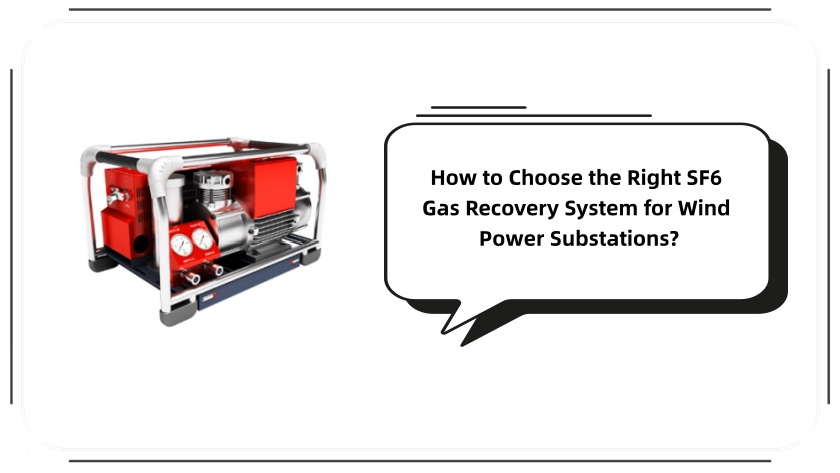
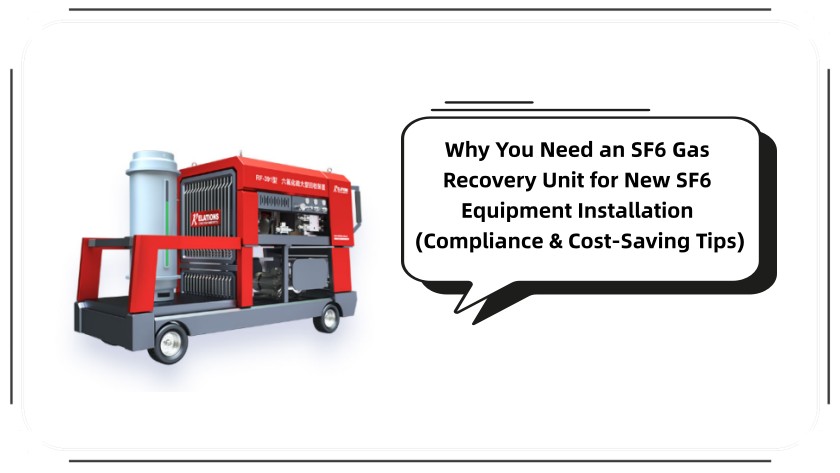
Mobility: Prioritize portable or mobile designs: Wind power substations are often scattered across mountainous, grassland, or coastal areas, and SF6 equipment (e.g., GIS, circuit breakers) may be distributed in multiple tower bases or small substations. Choose systems with:
Wheeled or trailer-mounted designs (e.g., 2-4 wheel configurations) for easy transportation between sites.
Compact size and lightweight (e.g., ≤300kg) to fit in narrow substation spaces or lift into tower bases.
Environmental adaptability: Resist harsh outdoor conditions: Wind power sites face extreme temperatures, humidity, or salt spray (for offshore wind). Focus on:
Protection level: At least IP54 (dustproof and splash-proof); offshore wind requires IP65 or higher (salt spray corrosion resistance).
Low-temperature startup capability: Ensure normal operation at -20℃ (or lower, for cold regions) without relying on external heating.
Corrosion-resistant materials: Use stainless steel or galvanized shells to avoid rust from high humidity or salt fog.
2. Strictly adhere to compliance standards for SF6 recovery
Compliance is non-negotiable; the SF6 gas recovery system must meet international and national standards applicable to wind power.
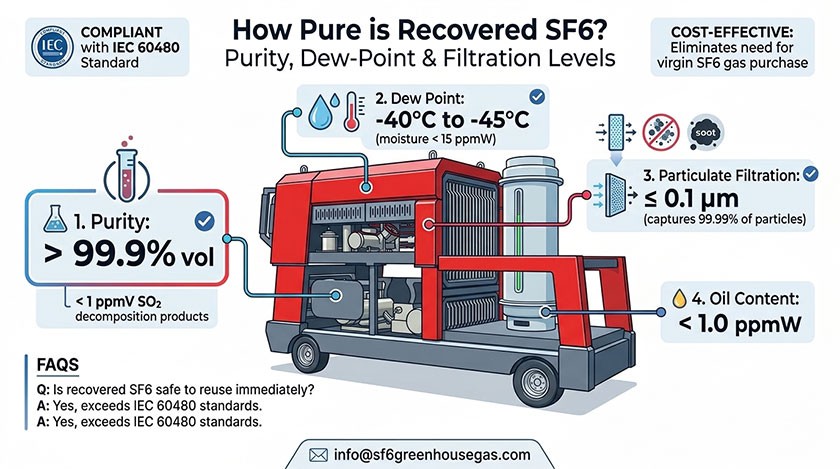
Core international standards: Must comply with IEC 60480 (the global benchmark for SF6 recovery), with key parameters:
SF6 recovery rate: ≥95% (to minimize gas waste and emissions, aligning with wind power’s low-carbon requirements).
Residual gas pressure after recovery: ≤50mbar (to ensure thorough recovery from small-volume SF6 equipment in wind substations).
National/industry-specific standards: Align with local regulations for wind power, such as:
China: GB/T 12022 (equivalent to IEC 60480) and DL/T standards (power industry norms for wind power equipment maintenance).
EU: EN 60480 and compliance with the EU F-Gas Regulation (requires emission tracking, so the system should have data logging functions).
3. Focus on core performance parameters matching wind power needs
Wind power substations have small SF6 equipment volumes (e.g., 10-50kg per GIS unit) and infrequent maintenance—so the SF6 gas recovery system’s performance must be "small but efficient."
Processing capacity: Match small-volume SF6 demand: Avoid oversized systems (which waste energy and money). Choose systems with a hourly recovery capacity of 5-10kg (suitable for most wind substation SF6 equipment; one unit can handle 2-3 substations per day).
Energy efficiency: Adapt to remote power supply limitations: Wind power sites may have unstable power or rely on generators. Select systems with:
Low power consumption (e.g., ≤3kW for 220V/380V AC; optional DC power supply for off-grid sites).
Energy-saving modes (e.g., automatic shutdown when recovery is complete to avoid idle power use).
Operation simplicity: Reduce on-site training costs: Wind substation staff often have limited SF6 operation experience. Choose systems with:
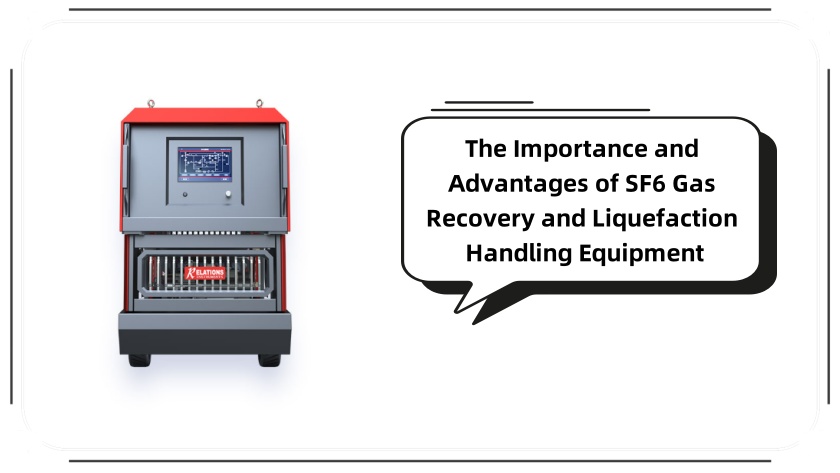
Touchscreen controls and one-key recovery functions (minimizing manual operation steps).
Fault self-diagnosis (e.g., alarm prompts for filter blockages or vacuum pump failures) to simplify troubleshooting.
4. Evaluate supplier support for wind power scenarios
Remote wind power sites depend heavily on after-sales service—poor support will lead to prolonged equipment downtime.
Localized service coverage: Confirm the supplier has service centers or authorized partners within 300km of the wind farm (to ensure on-site maintenance within 48 hours for critical faults).
Spare parts guarantee: Require the supplier to stock key spare parts (e.g., filters, vacuum pump oil, seals) in nearby warehouses, with a supply cycle of ≤3 days.
Wind power-specific training: Ask for customized training (e.g., "outdoor operation precautions" or "cold-weather maintenance") instead of generic industrial training—ensuring on-site staff can operate and maintain the SF6 gas recovery system independently.