High-precision SF6 Purity and Humidity Measurement for 500kV GIS Gas Recovery Equipment
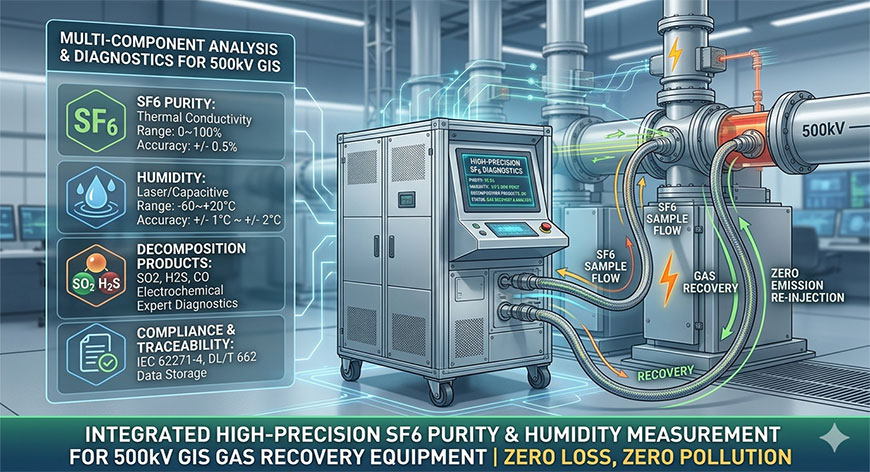
In the modern power grid, the 500kV Gas Insulated Switchgear (GIS) serves as a critical node for regional energy stability. As these systems rely heavily on Sulfur Hexafluoride (SF6) for insulation and arc quenching, the integrity of the gas medium is paramount. However, the operational challenges of maintaining 500kV equipment involve more than just containment; they require a sophisticated lifecycle management strategy.
Implementing high-precision SF6 purity and humidity measurement for 500kV GIS gas recovery equipment is no longer a luxury—it is a technical necessity. This integration ensures that during maintenance and recovery cycles, the gas remains within the stringent limits defined by international standards like IEC 62271-4 and local industrial benchmarks such as DL/T 662.
The Critical Role of High-Precision Diagnostics in 500kV Systems
The 500kV level represents a high-stress environment where even minor impurities in SF6 gas can lead to catastrophic insulation failure. When gas recovery equipment is deployed, it must do more than simply move gas from the GIS to a storage tank. It must act as a gatekeeper of quality.
1. Moisture: The Invisible Threat
High humidity levels in SF6 gas are the primary catalyst for the formation of toxic and corrosive by-products. In the presence of an arc or high-temperature partial discharge, moisture reacts with decomposed SF6 to produce hydrofluoric acid (HF) and sulfuric acid (H2SO4). These substances etch ceramic insulators and metallic components, leading to internal flashovers. Using laser-based or capacitive dew point sensors allows for real-time monitoring during the recovery process, ensuring the gas remains below the critical threshold (typically below -35°C for recovered gas).
2. Purity and Arc-Quenching Capability
SF6 purity directly correlates with its dielectric strength. Air or nitrogen ingress during recovery or top-ups dilutes the medium. For 500kV GIS, maintaining purity levels above 99.5% is essential. High-precision thermal conductivity sensors (TCD) integrated into recovery systems provide instantaneous feedback, allowing operators to decide whether the gas can be reused or requires further purification through molecular sieves.
Advanced Features of Integrated SF6 Analysis Systems
Modern gas management requires a shift from standalone "dumb" recovery units to "intelligent" integrated analysis and recovery platforms. The latest generation of comprehensive analyzers provides a closed-loop solution that targets "zero loss and zero pollution."
Multi-Component Decomposition Analysis
Beyond simple purity and humidity, the detection of decomposition products—specifically SO2, H2S, and CO—is vital for "health-index" based maintenance.
SO2 and H2S: These indicate recent discharge activity or overheating within the GIS.
CO: Often suggests the involvement of organic insulation materials in a fault.
By utilizing electrochemical sensors with a resolution of 0.1 microliters per liter, maintenance teams can perform expert diagnostics on-site, shifting from reactive repairs to predictive maintenance.
The "Zero Emission" Recovery Loop
The standout feature of high-end equipment is the re-injection and recovery function. Standard analyzers often vent the sample gas after testing. However, when dealing with 500kV volumes, this leads to cumulative environmental impact and gas loss.
Modern integrated units can:
Extract gas for analysis.
Store it in an internal buffer or external vessel.
Directly re-inject it into the GIS chamber once the measurement is complete.
This ensures that the "High-precision SF6 purity and humidity measurement for 500kV GIS gas recovery equipment" protocol adheres to the strictest environmental regulations regarding greenhouse gas emissions.
Technical Specifications and Engineering Standards
To meet the rigorous demands of power utilities, the technical parameters of the measurement modules must be uncompromising.
| Parameter | Detection Principle | Range | Accuracy |
| SF6 Purity | Thermal Conductivity | 0 to 100% | +/- 0.5% |
| Humidity (Dew Point) | Laser / Capacitance | -60 to +20°C | +/- 1°C to +/- 2°C |
| SO2 / H2S | Electrochemical | 0 to 100 microliters/liter | +/- 0.5 microliters/liter (low range) |
| CO | Electrochemical | 0 to 500 microliters/liter | +/- 2 microliters/liter (low range) |
The equipment must also handle varying pressure environments. With input pressures ranging from 0.4 to 2.0 MPa, it can interface directly with 500kV GIS intervals. The ability to recover gas into external cylinders at pressures less than or equal to 0.8 MPa ensures compatibility with standard logistics and storage equipment.
Conclusion: Future-Proofing Gas Management
The transition toward "Smart Grids" requires that every piece of hardware—including the recovery and analysis tools—be data-ready. The inclusion of an Expert Diagnosis System within the analyzer allows for immediate, on-site decision-making based on pre-set industrial standards. This reduces the margin for human error and ensures that 500kV GIS units are always operating with the highest quality insulation medium.
Investing in high-precision SF6 purity and humidity measurement for 500kV GIS gas recovery equipment is an investment in the longevity of the power infrastructure. By combining precision sensing with zero-emission recovery technology, utilities can achieve the dual goals of operational excellence and environmental stewardship.
Leave A Message
Your email address will not be published. Required fields are marked *
More Articles