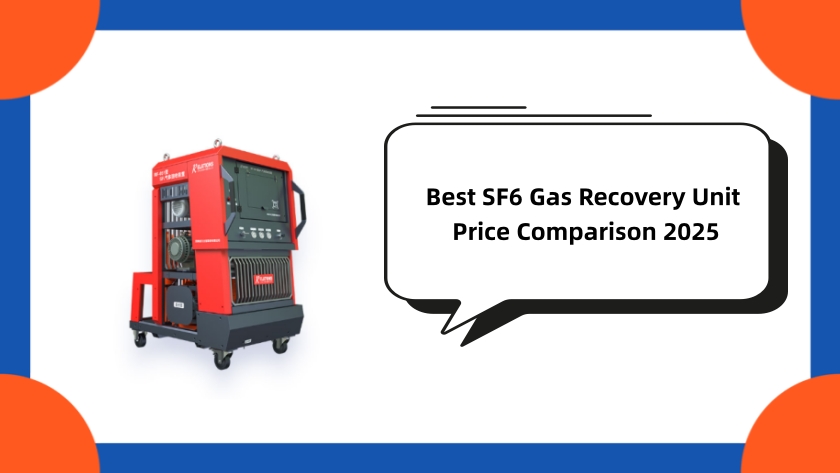
Best SF6 Gas Recovery Unit Price Comparison 2025
For utilities, industrial operators, and field service contractors managing sulfur hexafluoride (SF₆)-insulated equipment, selecting the right gas recovery unit is a high-stakes decision. With SF₆ carrying a global warming potential 23,500 times that of CO₂, regulatory scrutiny is intensifying worldwide—making proper gas handling not just an operational necessity but a legal and environmental imperative. Yet with recovery units ranging from 15,000toover60,000, buyers face a complex trade-off between cost, capability, and long-term value.
This article delivers a professional, data-driven best SF6 gas recovery unit price comparison, helping you navigate specifications, hidden costs, and total ownership value—so you invest wisely without compromising safety or compliance.
Why “Cheap” Isn't Always Cost-Effective
Many buyers focus solely on upfront SF6 gas recovery unit price, only to encounter costly pitfalls:
Underpowered compressors leading to incomplete recovery and extended downtime
Lack of onboard purification, requiring third-party reprocessing (100–200 per cylinder)
Poor build quality causing frequent breakdowns in the field
No digital logging, risking non-compliance fines (EPA penalties can exceed $10,000 per incident)
A true best SF6 gas recovery unit price comparison must evaluate total cost of ownership (TCO) over 5–10 years—not just the sticker price.
Key Performance Metrics That Impact Long-Term Value
When comparing SF6 gas recovery units, prioritize these technical differentiators:
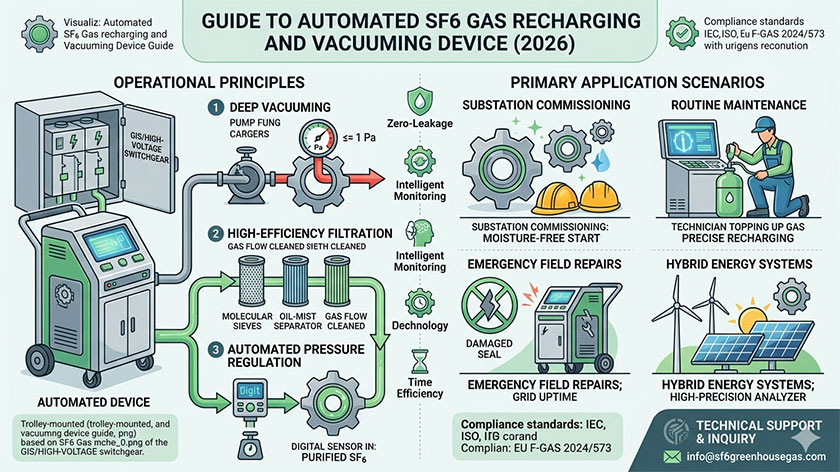
1. Recovery Speed & Final Vacuum
High-performance SF6 recovery units recover 40–60 kg/hour and achieve vacuum levels <1 mbar, meeting IEC 62271-4 standards. Slower units (<25 kg/hour) prolong outages—costing thousands in lost productivity per hour.
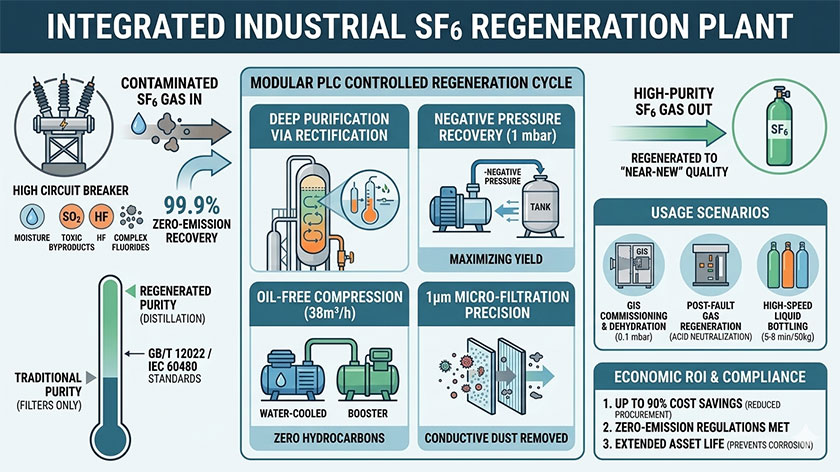
2. Onboard Purification
Units with integrated filters (activated alumina, molecular sieves) can purify recovered gas to IEC 60480 standards, enabling immediate reuse. This eliminates external processing fees and reduces virgin SF₆ purchases (50–100/kg).
3. Emission Control & Sealing
Closed-loop systems with DILO®-compatible couplings and automatic shut-offs prevent fugitive emissions—critical for EPA and EU F-Gas compliance.
4. Portability & Field Readiness
Compact models (<80 kg) with rugged wheels and universal voltage (100–240V) maximize deployment flexibility—especially for contractors serving multiple sites daily.
5. Digital Data Logging
GPS-tagged records of recovered mass, timestamps, and operator ID support audit readiness and ESG reporting.
Best SF6 Gas Recovery Unit Price Comparison: Top Models in 2025
Below is a rigorous comparison of leading units across three tiers—budget, mid-range, and premium—based on verified specs, user feedback, and service data.
| Model | Price Range | Recovery Rate | Purification? | Weight | Key Strengths |
|---|---|---|---|---|---|
| DILO B150 | 16,000–19,000 | 25 kg/h | Basic filter only | 95 kg | Low entry cost; reliable for light use |
| WIKA GPU-200 | 28,000–32,000 | 45 kg/h | Yes (IEC 60480) | 78 kg | Compact, digital logging, oil-free pump |
| MBW 973-SF6 | 42,000–48,000 | 55 kg/h | Advanced multi-stage | 82 kg | Highest purity output; cloud connectivity |
| EMT GHS 3-12 | 35,000–39,000 | 50 kg/h | Yes | 85 kg | Rugged design; ideal for harsh environments |
Note: Prices reflect U.S. market averages as of Q2 2025 and exclude shipping, taxes, or optional accessories.
Hidden Costs That Skew True Value
A thorough best SF6 gas recovery unit price comparison must account for:
Maintenance: Oil-lubricated compressors require annual servicing (~$800/year). Oil-free models reduce lifetime maintenance by 60%.
Downtime: A 2-hour longer recovery per job adds ~$1,200 in labor and outage costs annually (assuming 20 jobs/year).
Gas Loss: Units without precise mass measurement may vent 1–2% SF₆ per cycle—costing 100–200 in lost gas annually.
Compliance Risk: Lack of digital logs may disqualify contractors from utility bids requiring full SF₆ traceability.
When factoring these, a 30,000mid−tierunitoftendelivers∗∗lowerTCOthana17,000 budget model** over five years.
Who Should Buy What?
Small Contractors / Occasional Users: The DILO B150 offers acceptable performance for <10 jobs/year—but expect slower recovery and no reuse capability.
Mid-Sized Service Firms: The WIKA GPU-200 strikes the best balance—compact, compliant, and capable of on-site gas reuse. Ideal ROI for 20–50 annual jobs.
Large Utilities / Critical Infrastructure: The MBW 973-SF6 justifies its premium with lab-grade purification, remote diagnostics, and seamless integration into asset management systems.
Future-Proofing Your Investment
Regulations are tightening globally:
The EU plans to ban most SF₆ uses by 2030
The U.S. EPA is expanding mandatory reporting
Carbon pricing mechanisms increasingly include fluorinated gases
Choosing a SF6 recovery unit with digital traceability, high-purity output, and zero-emission design ensures your investment remains compliant—and valuable—for years to come.
Where to Buy: Authorized Channels Matter
While third-party marketplaces may offer lower prices, unauthorized sellers often lack:
Factory calibration certificates
Valid warranties (typically 2–3 years)
Access to firmware updates or technical support
Always purchase through manufacturer-authorized distributors (e.g., WIKA USA, DILO Direct, MBW AG partners) to guarantee authenticity and service coverage.
Conclusion: Value > Price in SF6 Recovery
The best SF6 gas recovery unit price comparison isn't about finding the cheapest option—it's about identifying the unit that delivers maximum reliability, compliance, and operational efficiency at a sustainable cost. In an era of climate accountability and grid resilience, cutting corners on SF6 handling risks far more than budget overruns.
By focusing on total ownership value—not just upfront cost—you protect your team, your clients, and the planet—while building a reputation for excellence in high-voltage service.
Leave A Message
Your email address will not be published. Required fields are marked *
More Articles