SF6 Gas Recycling Equipment for Zero-Greenhouse-Gas-Emission Certification Procurement 2026
As the global power industry moves toward the pivotal year of 2026, the transition to sustainable energy infrastructure is no longer a choice—it is a regulatory mandate. With the tightening of environmental standards worldwide, utility providers and industrial manufacturers are increasingly seeking sf6 gas recycling equipment for zero-greenhouse-gas-emission certification procurement 2026.
Sulfur Hexafluoride (SF6) remains the most effective insulating medium for high-voltage Gas-Insulated Switchgear (GIS). However, its Global Warming Potential (GWP) is approximately 23,500 times that of CO2. To bridge the gap between operational reliability and environmental stewardship, high-performance recycling technology has become the cornerstone of "Green Substation" certification.
1. The Strategic Importance of Zero-Emission Procurement in 2026
The year 2026 marks a significant milestone in international climate agreements, where "Net Zero" targets are being translated into local procurement requirements. For the power sector, this means that equipment must support a closed-loop lifecycle.
Procuring sf6 gas recycling equipment for zero-greenhouse-gas-emission certification is the primary method for utilities to prove they are preventing gas leakage during maintenance and decommissioning. By implementing a "Zero-Emission" workflow, companies can secure carbon credits, comply with environmental audits, and enhance their ESG (Environmental, Social, and Governance) ratings.
2. Revolutionary Modular Design: Overcoming Logistical Barriers
One of the most significant challenges in SF6 gas management is the physical accessibility of the equipment. Substations are often located in remote, mountainous areas or within confined indoor facilities where traditional, heavy-duty recovery plants cannot reach.
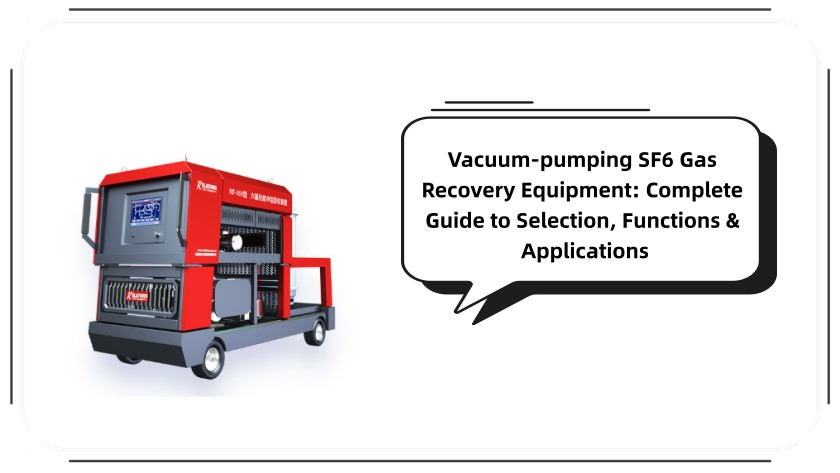
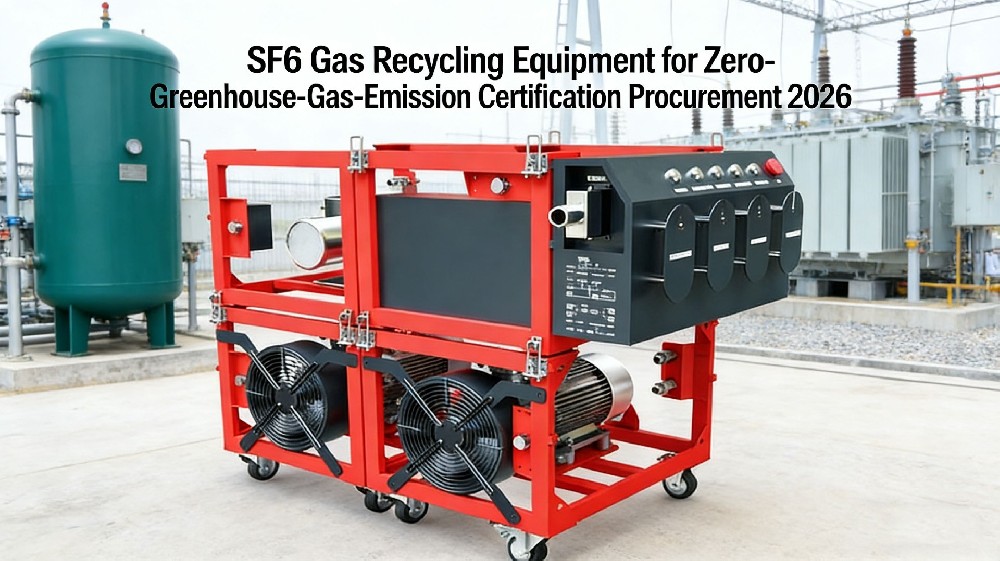
Our latest sf6 gas recycling equipment addresses these challenges through a unique modular combination design.
A. Modular Versatility The system is engineered as a series of interlocking modules. These units can be disassembled for transport in standard vehicles or through narrow indoor corridors and then reassembled on-site into a fully integrated processing plant. This flexibility is vital for zero-greenhouse-gas-emission certification procurement 2026, as it ensures that gas recovery can happen at every switchgear location, regardless of site complexity.
B. Standard Compliance and Safety The design and manufacturing of the equipment strictly adhere to DL/T 662 standards. This ensures that the recovery, purification, and recharging processes meet the highest levels of industrial safety and gas purity requirements.
3. High-Performance Technical Specifications
To achieve zero-emission targets, the sf6 gas recycling equipment must offer precision and power. The technical parameters of this modular unit are optimized for high-efficiency field operations.
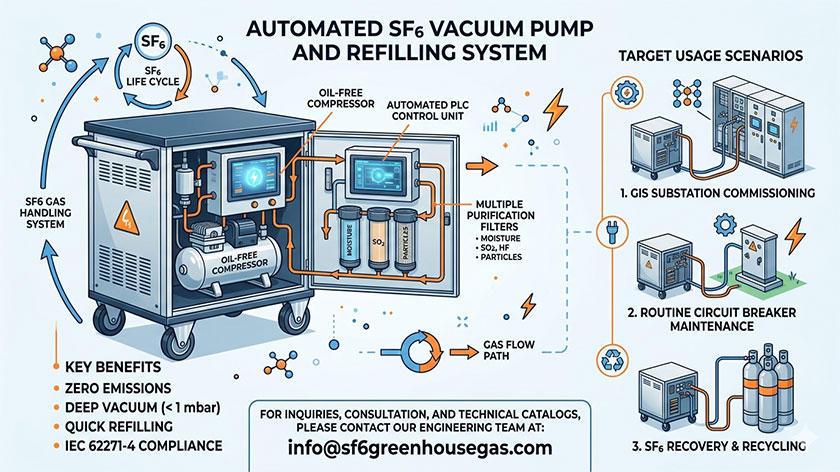
Oil-free Compressor: 8 cubic meters per hour recovery rate, final pressure of 50 bar.
Oil-free Scroll Pump: 7.2 cubic meters per hour suction speed, ultimate vacuum degree of 1 mbar or less.
Filtration Precision: 1 micrometer or less for solid particles.
Cooling Method: Mechanical refrigeration to ensure stability in various global temperatures.
Negative Pressure Recovery: Integrated to maximize recovery rates near 100%.
C. Negative Pressure Recovery for Maximum Efficiency Traditional recovery units often leave "heel" gas in the switchgear due to pressure equalization. Our equipment features a negative pressure recovery function, which actively pulls the gas out until the chamber reaches a vacuum state. This feature is essential for companies aiming for zero-emission certification, as it eliminates the trace emissions typically associated with disconnecting hoses from pressurized systems.
4. Purification and Life-Extension of SF6 Resources
For zero-greenhouse-gas-emission certification procurement 2026, recycling is not just about moving gas—it is about restoring it. During switchgear operation, SF6 can be contaminated with moisture, decomposition products (SO2, HF), and solid metallic particles.
The integrated filtration system in our recycling equipment utilizes advanced molecular sieves to capture these impurities. With a filtration precision of 1 micrometer or less, the output gas is returned to its "virgin" quality, suitable for immediate reinjection into 500kV GIS or storage for future use. This internal circular economy reduces the need for "new" SF6 production, directly lowering the utility's overall carbon footprint.
5. Global Adaptability: Adapting to 2026 Climate Realities
As global temperatures fluctuate, the efficiency of gas liquefaction—a critical step in SF6 storage—can be compromised. Our sf6 gas recycling equipment offers customizable refrigeration options.
By utilizing mechanical refrigeration tailored to the specific environment (from arid deserts to humid coastal substations), the unit ensures that SF6 is liquefied quickly and efficiently. This prevents "bottlenecks" during maintenance outages, allowing for faster turnarounds and more reliable grid performance.
6. Digital Integration and Procurement Compliance
In the context of procurement 2026, digital verification is as important as physical performance. This equipment is designed to interface with modern asset management systems:
Real-time Monitoring: Integrated vacuum and pressure gauges provide immediate feedback to operators.
Audit Readiness: By documenting the exact mass of gas recovered versus gas reinjected, utilities can provide a verifiable "Gas Balance Sheet" required for greenhouse gas emission certifications.
Ease of Operation: The modular interface is intuitive, reducing the training time for field technicians and minimizing the risk of accidental discharge due to operator error.
7. Strategic Applications Across Industries
While primarily designed for the power sector, the versatility of the sf6 gas recycling equipment for zero-greenhouse-gas-emission certification procurement 2026 makes it the preferred choice for several high-stakes applications:
Remote Substations: Modular disassembly allows for easy transport via small vehicles to isolated wind farms or mountain sites.
Indoor GIS Rooms: Compact dimensions and modularity allow the unit to fit through standard doorways and elevators in urban substations.
Manufacturing Quality Control: Ensuring that the production of SF6 equipment remains a zero-emission process from the factory floor to the field.
Conclusion: The Path to Net-Zero in 2026
The transition to a sustainable grid requires a combination of high-level policy and field-level precision. Our modular sf6 gas recycling equipment provides the technical foundation necessary for utilities to achieve zero-greenhouse-gas-emission certification.
By investing in oil-free, high-efficiency recovery and purification technology, power companies are not only complying with 2026 regulations but are also protecting the dielectric integrity of their most valuable assets. The future of energy is closed-loop, and modular recycling is the key to unlocking that future.
Leave A Message
Your email address will not be published. Required fields are marked *
More Articles