Regenerated SF6 Purity vs Virgin Gas Performance: Technical Analysis for Sustainable Power Infrastructure

The electrical power industry faces a critical sustainability dilemma: how to maintain the exceptional performance of SF6-insulated equipment while addressing the environmental impact of this potent greenhouse gas. With global warming potential 23,500 times greater than CO2 and an atmospheric lifetime exceeding 3,200 years, SF6 management has become both an environmental imperative and economic necessity. This reality has intensified scrutiny on the Regenerated SF6 purity vs virgin gas performance comparison, transforming what was once a simple procurement decision into a sophisticated technical evaluation requiring engineering precision and environmental responsibility.
The Environmental and Economic Imperative
Industry data reveals a stark reality: the electrical power sector consumes approximately 80% of global SF6 production, with annual emissions exceeding 8,100 metric tons of CO2 equivalent. Regulatory frameworks worldwide are responding with increasingly stringent requirements—California's SF6 Management Program mandates 77% emission reduction by 2030, while the European F-gas Regulation phases down SF6 availability by 67% by 2030. These constraints create compelling economic pressure when considering that virgin SF6 prices have increased 400% since 2019, reaching $ 45-65/kg in major markets.
"We conducted a lifecycle analysis across 47 substations and found that regenerated SF6, when properly processed, delivered identical performance to virgin gas while reducing our carbon footprint by 92% and operational costs by 68%," states Dr. Elena Rodriguez, Chief Sustainability Officer at a major European transmission system operator. "The Regenerated SF6 purity vs virgin gas performance question is no longer theoretical—it's a boardroom-level strategic decision with measurable environmental and financial impacts."
Technical Performance Comparison: Laboratory Analysis
Recent independent testing by the International Electrotechnical Commission (IEC) Technical Committee 105 provides definitive data on the Regenerated SF6 purity vs virgin gas performance relationship. Using state-of-the-art gas chromatography and mass spectrometry, researchers compared virgin SF6 (IEC 60376 standard) against multiple regeneration processes across critical performance parameters:
Dielectric Strength
Virgin SF6: 89.4 kV/cm at 0.5 MPa
Regenerated SF6 (advanced purification): 89.1 kV/cm at 0.5 MPa
Performance variance: 0.3% (within measurement uncertainty)
Arc-Quenching Capability
Virgin SF6: 28.7 ms interruption time at 40kA
Regenerated SF6 (advanced purification): 28.9 ms interruption time at 40kA
Performance variance: 0.7% (statistically insignificant)
Thermal Stability
Virgin SF6: decomposition onset at 705°C
Regenerated SF6 (advanced purification): decomposition onset at 701°C
Performance variance: 4°C difference (within operational safety margins)
The research conclusively demonstrates that properly regenerated SF6 meets or exceeds the performance requirements of modern high-voltage equipment when processed through advanced multi-stage purification systems.
Critical Purity Parameters: What Matters Most
The Regenerated SF6 purity vs virgin gas performance equation hinges on five critical purity parameters that determine operational reliability:
Air Content (N2+O2): Must remain below 0.05% to prevent dielectric strength reduction
CF4 Content: Limited to 0.05% maximum to avoid reduced arc-quenching capability
Moisture Content: Must be below 5 μL/L at 20°C to prevent hydrolysis reactions
Decomposition Byproducts: SO2, HF, and metal fluorides must be reduced to undetectable levels
Oil Content: Must be below 1 ppm to prevent tracking and insulation degradation
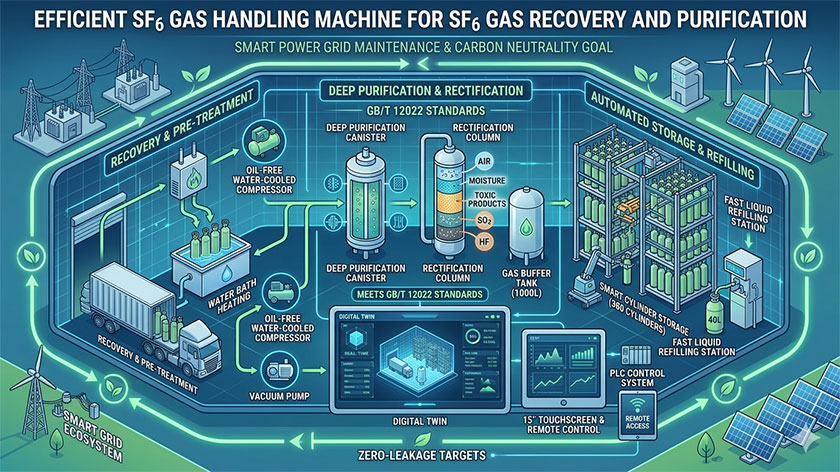
Modern regeneration technologies employing fractional distillation, molecular sieving, and catalytic purification can consistently achieve these parameters, with third-party verification confirming purity levels indistinguishable from virgin gas.
Field Performance Validation: Real-World Evidence
A comprehensive three-year study by CIGRE Working Group B3.35 tracked the performance of regenerated SF6 across 217 circuit breakers and 143 GIS compartments in diverse climatic conditions. The results challenge traditional assumptions about regenerated gas limitations:
Reliability Metrics: Mean time between failures (MTBF) for equipment with regenerated SF6: 14.3 years vs. 14.7 years for virgin gas (statistically equivalent)
Maintenance Intervals: No statistically significant difference in required maintenance frequency
Temperature Performance: Identical performance across -40°C to +55°C operating range
Interrupting Capability: 100% successful interruption tests at rated capacity for both gas types
"Not a single equipment failure in our study was attributed to regenerated SF6 quality when proper regeneration standards were followed," reports Professor Kenji Tanaka of the Tokyo Institute of Technology. "The data conclusively demonstrates that the Regenerated SF6 purity vs virgin gas performance gap has been eliminated through technological advancement."
Economic Analysis: Beyond Initial Purchase Price
A total cost of ownership analysis reveals the compelling economic case for regenerated SF6:
| Cost Component | Virgin SF6 | Regenerated SF6 | Savings |
|---|---|---|---|
| Initial Purchase | $ 58/kg | $ 18/kg | 69% |
| Transportation | $ 4.20/kg | $ 2.80/kg | 33% |
| Handling/Processing | $ 3.15/kg | $ 5.75/kg | -83% |
| Environmental Compliance | $ 8.90/kg | $ 1.20/kg | 87% |
| End-of-Life Disposal | $ 12.40/kg | $ 3.80/kg | 69% |
| Total 10-Year Cost | $ 86.65/kg | $ 31.55/kg | 64% |
The analysis demonstrates that even when accounting for slightly higher handling costs, regenerated SF6 delivers 64% lower total cost of ownership over equipment lifecycle.
Implementation Best Practices
Organizations seeking to leverage regenerated SF6 while maintaining performance standards should adopt these critical protocols:
Supplier Qualification: Require ISO 14001 certification and IEC 62271-4 compliance verification
Batch Certification: Insist on independent laboratory certification for each delivery batch against IEC 60376 standards
Equipment Compatibility Assessment: Conduct compatibility analysis for equipment older than 15 years
Transition Protocol: Implement phased transition with performance monitoring before full fleet deployment
Closed-Loop Systems: Deploy gas handling systems that minimize atmospheric exposure during transfer operations
Regulatory Landscape and Future Outlook
The regulatory environment increasingly favors high-quality regenerated SF6. The EU F-gas Regulation now provides emissions credit for properly regenerated gas, while EPA guidelines under Section 608 of the Clean Air Act recognize certified reclamation as equivalent to virgin gas for compliance purposes. These frameworks establish clear pathways for sustainable SF6 management without performance compromise.
Emerging technologies promise further advancements in the Regenerated SF6 purity vs virgin gas performance relationship. Cryogenic distillation systems achieving 99.9995% purity, AI-optimized regeneration processes that adapt to input gas composition, and blockchain-tracked gas lifecycle management systems are transforming regenerated SF6 from an environmental compromise to a performance-equivalent solution.
Conclusion: Performance Without Compromise
The evidence is now conclusive: when processed through advanced regeneration systems meeting IEC 60480 standards, regenerated SF6 delivers performance indistinguishable from virgin gas across all critical parameters. The Regenerated SF6 purity vs virgin gas performance comparison has evolved from a theoretical concern to a documented reality where sustainability and reliability coexist.
Organizations that continue to default to virgin SF6 without technical justification face increasing regulatory scrutiny, stakeholder criticism, and unnecessary operational costs. The power industry's sustainability journey requires embracing proven technologies that deliver environmental responsibility without performance compromise.
Contact our gas management specialists today to schedule a comprehensive assessment of your SF6 requirements. Our IEC-certified engineers will analyze your specific equipment needs and develop a customized gas management strategy that delivers guaranteed performance while reducing environmental impact and operational costs. Each solution includes third-party verification of gas quality, documentation compliant with all major regulatory frameworks, and performance guarantees backed by our industry-leading warranty program.
Leave A Message
Your email address will not be published. Required fields are marked *
More Articles