Testing SF6 Gas Recovery Units for Environmental Protection and Grid Connection Compliance
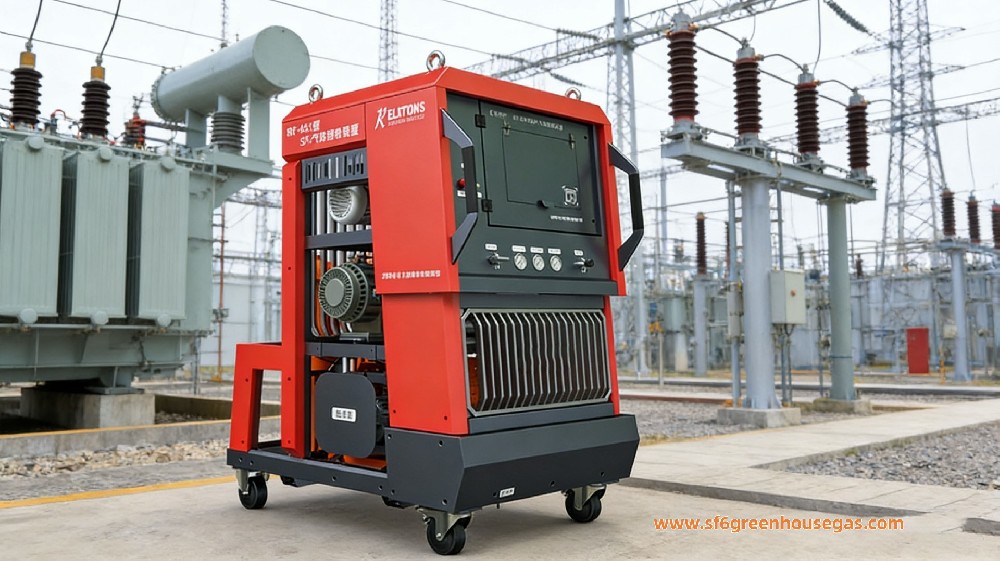
Ensuring SF6 gas recovery units meet environmental protection and grid connection standards requires a comprehensive testing protocol that addresses both equipment performance and regulatory compliance. Below is a systematic approach to verification and validation:
Environmental Protection Compliance Testing
1. Emission Control Verification
Leak Rate Testing: Conduct helium mass spectrometer testing at 1.5× operating pressure to verify leak rates below 0.5% per year (EPA Method 21)
Closed-Loop Integrity Assessment: Perform pressure decay tests on all connections and valves over 24-hour periods
Venting Prevention Systems: Validate automatic shut-off mechanisms that prevent operator error from causing atmospheric releases
2. Gas Purity Verification
Post-Recovery Analysis: Use calibrated gas chromatographs to verify recovered SF6 meets IEC 60480 standards:
Minimum 99.9% purity
Moisture content <40 ppm (ideally <10 ppm)
Air content <0.05%
CF4 content <0.02%
Oil content <5 ppm
Filter Efficiency Testing: Challenge filtration systems with calibrated contaminant mixtures to verify removal efficiency
3. Refrigerant Management Compliance
Refrigerant Handling Certification: Ensure all service personnel possess EPA 608 certification or equivalent regional credentials
Refrigerant Recovery Verification: Test auxiliary cooling systems for zero refrigerant emissions during maintenance procedures
Grid Connection and Electrical Standards Testing
1. Equipment Safety Certification
Electrical Safety Testing: Verify compliance with IEC 61010-1 for electrical safety of measurement and control equipment
EMC Compliance: Conduct electromagnetic compatibility testing per IEC 61000-6-2/4 to prevent interference with grid monitoring systems
Dielectric Strength Verification: Test all electrical components at 2× operating voltage plus 1,000V for 1 minute
2. Grid Support Functionality
Power Quality Assessment: Measure harmonic distortion during operation to ensure compliance with IEEE 519 standards
Voltage Fluctuation Testing: Verify equipment doesn't cause excessive voltage variations during startup/shutdown cycles
Protection System Coordination: Test integration with facility protection systems to ensure proper response during grid disturbances
Comprehensive Performance Testing Protocol
Factory Acceptance Testing (FAT)
Vacuum Performance Verification:
Measure ultimate vacuum levels (must achieve ≤0.1 mbar)
Conduct vacuum holding tests for minimum 30 minutes with <5% pressure rise
Recovery Rate Calibration:
Document recovery rates at various ambient temperatures
Verify performance at minimum design temperature (-25°C) and maximum temperature (+45°C)
Filtration System Validation:
Introduce calibrated contaminant mixtures (moisture, oil, decomposition products)
Analyze output gas quality after processing through complete system
Field Acceptance Testing (FAT)
Real-World Performance Verification:
Conduct recovery operations on actual switchgear
Measure purity before and after processing
Document time efficiency and resource consumption
Operator Procedure Validation:
Verify usability by trained personnel following standard operating procedures
Document any procedural adjustments needed for consistent compliance
Certification and Documentation Requirements
Required Certifications
CE Marking with notified body assessment for EU markets
UL/CSA certification for North American deployments
State Grid Corporation of China (SGCC) certification for Chinese grid applications
DL/T 662-2018 compliance verification report from accredited laboratory
IEC 62271-4 validation for high-voltage switchgear gas handling equipment
Documentation Package
Test Reports from accredited third-party laboratories
Material Safety Data Sheets for all filters and consumables
Calibration certificates for all measurement instruments
Environmental impact assessment including carbon footprint calculations
Operator training certification records and training materials
Maintenance schedules aligned with manufacturer recommendations and regulatory requirements
Ongoing Compliance Monitoring
Continuous Monitoring Systems
Digital logging capabilities for all recovery operations with tamper-proof records
Cloud-based reporting systems that automatically generate regulatory compliance reports
Predictive maintenance alerts based on usage patterns and component lifecycles
Periodic Recertification
Annual performance verification by independent testing organization
Biennial regulatory compliance audit including documentation review
Five-year comprehensive reassessment of all system components and procedures
Best Practices for Ensuring Compliance
Implement digital tracking systems that create immutable records of all gas handling activities
Establish chain-of-custody protocols for all recovered and processed SF6
Conduct quarterly internal audits against regulatory requirements
Participate in industry proficiency testing programs to benchmark equipment performance
Maintain direct communication channels with regulatory authorities to stay ahead of changing requirements
By implementing this comprehensive testing framework, utilities and industrial facilities can ensure their SF6 gas recovery units not only meet current environmental protection and grid connection standards but are positioned to adapt to increasingly stringent future regulations. The investment in proper verification pays substantial dividends through reduced environmental liability, extended equipment life, and uninterrupted grid operations.
Leave A Message
Your email address will not be published. Required fields are marked *
More Articles