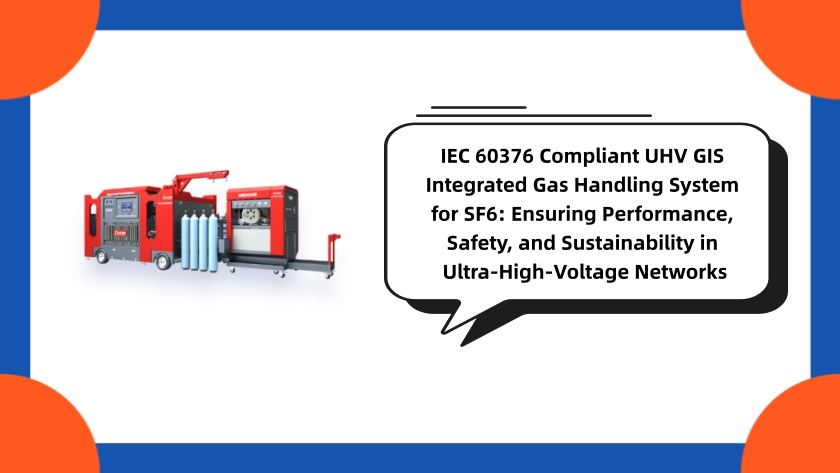
IEC 60376 Compliant UHV GIS Integrated Gas Handling System for SF6
As global electricity demand surges and grids integrate more renewable energy, ultra-high-voltage (UHV) gas-insulated switchgear (GIS)—operating at 330 kV, 500 kV, and beyond—has become critical for efficient, compact, and reliable power transmission. Central to this technology is sulfur hexafluoride (SF6), the industry-standard insulating gas prized for its exceptional dielectric strength and arc-quenching capabilities.
However, the performance of UHV GIS is only as reliable as the quality of the SF6 it contains. Even trace impurities—moisture, air, or decomposition byproducts—can compromise insulation integrity, trigger partial discharges, and lead to catastrophic failures. To mitigate these risks, utilities and transmission system operators must deploy an IEC 60376 compliant UHV GIS integrated gas handling system for SF6—a purpose-built solution that ensures gas purity from commissioning through decades of operation.
Why IEC 60376 Compliance Is Non-Negotiable for UHV Applications
Published by the International Electrotechnical Commission (IEC), IEC 60376 defines the strict specifications for new technical-grade SF6 used in electrical equipment. For UHV systems—where electric fields are extreme and tolerances razor-thin—adherence to this standard isn’t optional; it’s foundational.
Key IEC 60376 limits include:
Air (N₂ + O₂): ≤ 0.05%
CF₄ (carbon tetrafluoride): ≤ 0.05%
Moisture (H₂O): ≤ 5 µg/g (≈ –49.5°C dew point)
Oil content: ≤ 10 µg/g
Purity (SF6): ≥ 99.9%
Exceeding any of these thresholds—even slightly—can initiate internal corrosion, reduce dielectric margin, or accelerate aging under high stress. In UHV environments, such deviations don’t just degrade performance—they risk multi-million-dollar outages and grid instability.
This is where an IEC 60376 compliant UHV GIS integrated gas handling system for SF6 delivers unmatched value: it doesn’t just transfer gas—it guarantees compliance at every stage.
What Defines a True Integrated Gas Handling System?
Unlike standalone recovery carts, an integrated system is engineered as part of the GIS lifecycle—from factory filling to on-site maintenance and end-of-life reclamation. Key attributes include:
1. Closed-Loop Architecture
Prevents atmospheric contamination during filling, evacuation, or servicing. All processes occur within a sealed circuit, maintaining gas integrity per IEC 62271-4 (handling procedures).
2. Onboard Purification & Analysis
Integrated filters (molecular sieve, alumina, activated carbon) remove moisture, oil, and decomposition products. Real-time sensors monitor dew point, purity, and SO₂—ensuring output meets IEC 60376 before injection.
3. Automated Process Control
Programmable logic controllers (PLCs) manage evacuation depth (<0.1 mbar), filling pressure, and gas circulation—eliminating human error and ensuring repeatability across global sites.
4. Digital Traceability
Every batch of SF6 is logged with timestamped data: source cylinder ID, purity pre/post filtration, moisture levels, and operator credentials. This supports ISO 50001, IEC 62448 (gas management), and ESG reporting.
5. Scalability for UHV Volumes
UHV bays can contain 200–500 kg of SF6. High-capacity compressors, large buffer tanks, and rapid-transfer manifolds minimize downtime during commissioning or emergency servicing.
Operational Benefits Across the Asset Lifecycle
Commissioning: Guarantees first-fill SF6 meets IEC 60376—avoiding costly delays due to failed gas tests.
Maintenance: Enables on-site purification and reuse, eliminating the need to ship contaminated gas offsite.
Decommissioning: Recovers >99% of SF6 for recycling or destruction, supporting circular economy goals.
Fault Diagnostics: Integrated analyzers detect early signs of arcing (e.g., SO₂, HF), enabling predictive interventions.
For example, a 500 kV GIS bay filled with non-compliant gas (moisture at 10 µg/g vs. 5 µg/g limit) may pass initial tests but develop ice crystals during cold snaps—triggering flashovers. An IEC 60376 compliant UHV GIS integrated gas handling system for SF6 prevents such latent failures.
Regulatory and Environmental Imperatives
With SF6 under increasing scrutiny globally—banned in non-essential applications in the EU and subject to EPA reporting in the U.S.—utilities must demonstrate responsible stewardship. IEC 60376 compliance is now a baseline expectation in:
Tender specifications (e.g., World Bank, ADB-funded projects)
Grid codes (e.g., ENTSO-E, ASEAN Power Grid guidelines)
Corporate sustainability frameworks (Scope 1 GHG accounting)
Moreover, using certified SF6 gas handling systems reduces lifecycle emissions by enabling closed-loop reuse—turning environmental compliance into operational advantage.
Choosing the Right System: Technical and Strategic Criteria
When evaluating solutions, prioritize vendors who:
Provide third-party test certificates verifying IEC 60376 output
Offer integration with OEM GIS platforms (e.g., Siemens, Hitachi, GE, XD Group)
Support remote diagnostics and firmware updates
Maintain global service networks with trained IEC 62271-4-certified technicians
Avoid “semi-integrated” kits that require manual valve switching or lack real-time analytics—these introduce contamination risks and compliance gaps.
Conclusion: Raising the Standard for UHV Reliability
In the era of smart grids and net-zero commitments, UHV infrastructure must deliver both performance and responsibility. An IEC 60376 compliant UHV GIS integrated gas handling system for SF6 is not merely a piece of equipment—it's a strategic enabler of grid resilience, regulatory alignment, and environmental accountability.
By embedding gas quality assurance into the core of GIS operations, transmission owners protect their most critical assets—and the communities that depend on them.
Leave A Message
Your email address will not be published. Required fields are marked *