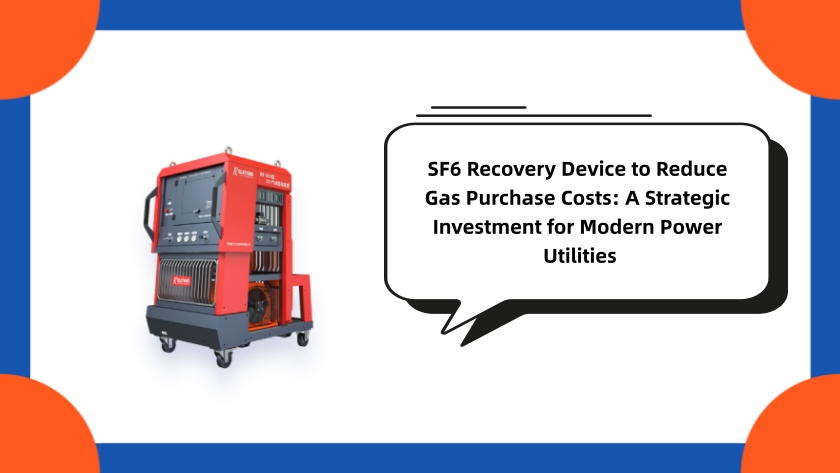
SF6 Recovery Device to Reduce Gas Purchase Costs
Sulfur hexafluoride (SF₆) remains indispensable in high-voltage electrical infrastructure due to its unmatched dielectric strength and arc-quenching capabilities. However, its soaring cost—ranging from 25to50 per kilogram—and extreme global warming potential (23,500 times that of CO₂) make uncontrolled usage financially and environmentally unsustainable. For utilities, industrial operators, and EPC contractors managing Gas-Insulated Switchgear (GIS), circuit breakers, or substations, the smartest path forward is clear: deploy an SF6 recovery device to reduce gas purchase costs while ensuring compliance and operational reliability.
This article examines how modern SF6 recovery technology delivers immediate ROI, supports ESG goals, and future-proofs grid operations—all through intelligent gas reuse.
The Hidden Cost of “Top-Up” Mentality
Many organizations still treat SF₆ as a consumable: when pressure drops, they simply refill with new gas. This approach ignores two critical realities:
SF₆ is expensive and price-volatile—subject to supply chain constraints and regulatory tariffs (e.g., EU F-Gas quotas).
Venting or losing gas during maintenance is illegal in most jurisdictions, including under U.S. EPA rules and ASEAN environmental guidelines.
A typical 400 kV GIS bay holds 200–400 kg of SF₆. Even a 1% annual leak—common in aging systems—represents 2–4 kg lost, or 100–200 in avoidable annual costs per bay. Across a network of 50 bays, that’s 5,000–10,000+ wasted yearly—not including fines or carbon liabilities.
By contrast, using an SF6 recovery device to reduce gas purchase costs enables closed-loop recycling: capture used gas, purify it, and reuse it safely—dramatically cutting reliance on virgin SF₆.
How an SF6 Recovery Device Lowers Operational Expenditure
A professional-grade SF6 recovery device to reduce gas purchase costs integrates three core functions:
1. High-Efficiency Recovery
Advanced units use multi-stage compressors and deep vacuum pumps to extract >99% of SF₆ from equipment—even down to residual pressures below 1 mbar. This maximizes gas capture during servicing, decommissioning, or leak repairs.
2. Onboard Purification
Contaminants like moisture, oil, and arc byproducts (SO₂, HF) degrade insulation performance. Integrated filtration systems—using molecular sieves, coalescing filters, and chemical absorbents—clean the gas to meet IEC 60480 standards for reuse in electrical equipment.
3. Storage and Re-filling Capability
Recovered and purified SF₆ is stored in high-pressure cylinders (up to 300 bar) and can be directly re-injected into GIS or breakers—eliminating the need for new purchases.
The result? Utilities routinely cut SF₆ procurement by 40–70%, with payback periods as short as 12–18 months.
Real Financial Impact: Case Examples
Southeast Asian Utility: After deploying five mobile SF₆ recovery units across its transmission network, the company reduced annual SF₆ purchases from 1,200 kg to 400 kg—saving 20,000–40,000 per year (depending on market pricing).
European DSO: By mandating recovery during all GIS maintenance, the utility avoided €35,000 in gas costs and €12,000 in F-Gas compliance penalties over two years.
Industrial Plant (Philippines): Reusing purified SF₆ eliminated emergency top-ups during typhoon season, improving substation uptime and avoiding PHP 150,000 in unplanned outage costs.
These examples prove that an SF6 recovery device to reduce gas purchase costs isn’t just an environmental tool—it’s a financial asset.
Beyond Savings: Compliance, Safety, and ESG Value
While cost reduction is compelling, the full value extends further:
Regulatory Compliance: The EU F-Gas Regulation, U.S. EPA GHG Reporting Rule, and emerging ASEAN policies prohibit intentional venting and require documented recovery. Digital-capable units generate audit-ready certificates.
Grid Reliability: Reusing clean, dry SF6 prevents dielectric failure—critical in tropical climates with high humidity.
ESG Credibility: Verified SF6 recycling data strengthens sustainability disclosures under frameworks like TCFD, CDP, and SEC climate rules.
Technician Safety: Closed-loop handling minimizes exposure to toxic decomposition products generated during arcing.
In today’s investment landscape, lenders and insurers increasingly tie financing terms to verified emission reductions—making recovery devices a gateway to green capital.
Choosing the Right SF6 Recovery Device
Not all units deliver equal ROI. Look for these features in an SF6 recovery device to reduce gas purchase costs:
Recovery rate: ≥40 kg/h for practical field use
Final vacuum: ≤1 mbar to maximize extraction
Purity output: <10 ppm H₂O, <1 ppm SO₂ (per IEC 60480)
Digital logging: Timestamped records of volume recovered, operator ID, and asset tag
Mobility: Skid-mounted or trailer-based for multi-site operations
Leading models include:
DILO B125R01: Compact, efficient, ideal for distribution networks
WIKA GPU-20: All-in-one recovery, purification, and filling with optional cloud reporting
MBW 973-SF6 + Recovery Cart: High-precision analysis paired with robust recovery
All are supported by regional service centers in Singapore, Manila, and Bangkok—ensuring calibration, training, and spare parts availability.
Best Practices for Maximum ROI
To fully leverage your SF6 recovery device to reduce gas purchase costs:
Train certified technicians per IEC 62271-4 standards
Mandate recovery during every maintenance job—no exceptions
Test gas purity before reuse in critical assets
Track savings monthly: Compare pre- and post-deployment SF₆ invoices
Integrate data into ESG reports to showcase climate action
Conclusion: Turn Waste into Worth
An SF6 recovery device to reduce gas purchase costs transforms a high-risk expense into a controlled, reusable resource. It delivers hard cost savings, ensures regulatory safety, and demonstrates genuine environmental leadership.
For any organization managing high-voltage infrastructure, the question isn’t whether to invest—but how soon. In an era of rising gas prices and climate accountability, recovery isn’t optional. It’s essential.
Leave A Message
Your email address will not be published. Required fields are marked *
More Articles