SF6 Gas Vacuuming and Gas Recovery Integrated Unit for GIS Maintenance Petrochemical
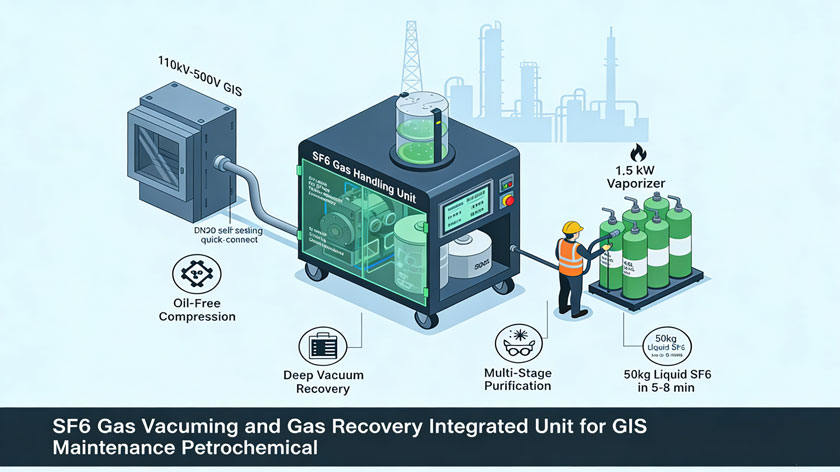
In the high-stakes environment of petrochemical refining and chemical processing, electrical infrastructure is the silent heartbeat of production. Gas-Insulated Switchgear (GIS) operating between 110kV and 500kV provides the necessary power density and reliability for these facilities. However, the management of Sulfur Hexafluoride (SF6)—the insulating medium—presents complex challenges in terms of purity, safety, and environmental impact.
The SF6 gas vacuuming and gas recovery integrated unit for GIS maintenance petrochemical is an essential piece of equipment designed to bridge the gap between high-voltage operational needs and strict environmental mandates. This article explores why an integrated, modular approach to gas handling is the gold standard for modern industrial power systems.
1. The Strategic Importance of Integrated SF6 Management
Petrochemical plants are often located in environments with extreme temperatures and corrosive atmospheres. The electrical switchgear in these plants must be maintained with zero margin for error. An "integrated unit" is not just a pump; it is a multi-functional mobile laboratory that handles vacuuming, recovery, purification, and refilling within a single closed-loop system.
Why Integration Matters in Petrochemical Settings:
Risk Mitigation: Minimizing the number of separate devices reduces the risk of connection leaks and atmospheric exposure.
Time Efficiency: In a refinery, downtime is measured in millions of dollars. An integrated unit accelerates the transition between recovery and refilling.
Asset Longevity: By removing moisture and decomposition products, the unit prevents internal corrosion of the GIS, extending its service life beyond 30 years.
2. Technical Core: Engineered for High-Performance Recovery
When evaluating an SF6 gas vacuuming and gas recovery integrated unit for GIS maintenance petrochemical, the technical specifications must align with DL/T 662 standards. This ensures the unit can handle the high volumes associated with large-scale GIS bays.
High-Efficiency Recovery and Compression
The heart of the unit is a 30 m3/h oil-free water-cooled compressor. Unlike standard lubricated compressors, oil-free technology ensures that the insulating gas is never contaminated by lubricant vapors. When combined with a 5 m3/h oil-free booster specifically designed for liquid SF6, the unit can achieve a high-pressure output of 50 bar, allowing for efficient storage in cylinders or tanks.
Deep Vacuum and Negative Pressure Recovery
To achieve a "99.9% recovery rate," the unit must be capable of negative pressure recovery. By pulling a deep vacuum, the unit ensures that almost no residual gas remains in the switchgear before it is opened for maintenance. The integrated PLC operating screen provides real-time monitoring of vacuum levels, ensuring operators can verify the completeness of the process.
3. Advanced Purification: The Key to Gas Re-use
Recovered SF6 is rarely pure. Arcing during breaker operation creates toxic decomposition products (such as SO2 and HF), while temperature fluctuations can introduce moisture.
Multi-Stage Filtration System:
The integrated unit features a sophisticated filtration array that protects both the environment and the personnel:
Moisture Absorption: Desiccant stages lower the dew point to meet GB/T 12022 standards.
Chemical Neutralization: Specialized filters remove acidic decomposition products.
Particulate Capture: With a filtration accuracy of less than or equal to 1 micrometer, the unit removes microscopic metal dust and solid arc byproducts that could damage switchgear seals.
4. Operational Versatility: From Direct Refilling to Liquid Charging
A standout feature of this integrated unit is its flexibility in gas output. Petrochemical maintenance teams often face different scenarios—from topping up a single breaker to charging high-pressure gas cylinders for off-site storage.
Direct Refilling: The unit supports direct charging with an adjustable pressure output of 1 to 10 bar.
Cylinder Charging: The high-pressure booster can fill a 40 L cylinder with 50 kg of liquid SF6 in just 5 to 8 minutes.
Integrated Vaporization: Equipped with a 1.5 kW vaporizer, the unit can rapidly convert liquid SF6 back into gas for refilling, even in cold climates where natural evaporation is too slow.
5. Technical Specification Overview
| Feature | Specification | Petrochemical Benefit |
| Compressor | 30 m3/h (Oil-free) | Fast, clean recovery without contamination. |
| Liquid Booster | 5 m3/h | Rapid cylinder filling (5-8 min). |
| Filtration Rating | <= 1 micrometer | Prevents seal damage in 500kV GIS. |
| Structure | Semi-enclosed / Modular | Easy maintenance and rugged protection. |
| Output Pressure | 50 bar | High-density storage capability. |
| Vaporizer Power | 1.5 kW | High-speed refilling in all weather conditions. |
6. Regulatory Compliance and ESG Goals
For major petrochemical firms, compliance with environmental regulations is a top-tier priority. Using an SF6 gas vacuuming and gas recovery integrated unit is a primary evidence of a facility's commitment to ESG (Environmental, Social, and Governance) goals.
DL/T 662 Compliance: Ensures the equipment is built to the rigorous standards required by the power industry.
Personnel Safety: The unit’s anti-suckback valve on the vacuum pump and negative pressure recovery features protect workers from exposure to toxic gas byproducts.
Carbon Footprint Reduction: By ensuring a closed-loop system, the unit prevents the release of SF6, which is 23,500 times more potent than CO2.
7. Selecting the Right Unit: A Procurement Checklist
When sourcing an integrated unit for petrochemical GIS maintenance, procurement managers should prioritize the following:
Refrigeration Adaptability: Does the unit offer different cooling options (like water-cooled or air-cooled) to suit your specific regional climate?
Hose Quality: Ensure the unit comes with high-grade DN19 recovery and DN13 refilling hoses with self-sealing DN20 connectors to prevent "puff" losses.
Automation: A PLC-driven interface is essential for minimizing human error and providing accurate data for environmental reporting.
Modular Serviceability: A modular design allows for individual components (like the compressor or filters) to be serviced without dismantling the entire unit.
8. Conclusion: Maximizing Reliability and Sustainability
The SF6 gas vacuuming and gas recovery integrated unit for GIS maintenance petrochemical is more than just a tool; it is a critical safeguard for the energy infrastructure of a refinery. By integrating high-speed vacuuming, oil-free compression, and deep purification into a single modular chassis, it provides the reliability required for 110kV to 500kV systems.
As global environmental standards tighten, the move toward intelligent, integrated recovery systems is no longer optional. Investing in high-performance recovery technology ensures that petrochemical facilities can maintain their power systems safely, efficiently, and in full harmony with their sustainability commitments.
Leave A Message
Your email address will not be published. Required fields are marked *
More Articles