Does the on-site SF6 gas recovery and recycling system meet IEC 60480 standards for direct gas reuse?
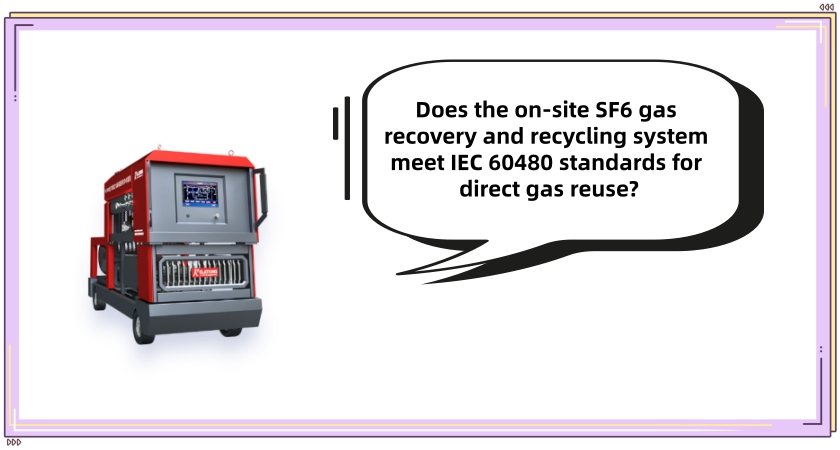
Yes—a properly designed on-site SF6 gas recovery and recycling system can meet IEC 60480 standards for direct gas reuse, but only if it includes sufficient purification capacity and real-time or post-process verification of gas quality.
Understanding IEC 60480
IEC 60480 is the international standard titled "Guidelines for the checking and treatment of sulfur hexafluoride (SF₆) taken from electrical equipment and specification for its re-use." It defines maximum allowable limits for impurities in recovered SF₆ intended for reuse in electrical equipment, including:
| Parameter | IEC 60480 Limit |
|---|---|
| SF₆ Purity | ≥ 99.9% by weight |
| Air (N₂ + O₂) | ≤ 0.2% |
| CF₄ | ≤ 0.05% |
| Moisture (H₂O) | ≤ 10 µg/g (dew point ≤ –36°C at 0.5 MPa) |
| Decomposition products (e.g., SO₂, HF, SOF₂) | ≤ 1–3 µg/g (varies by compound) |
| Oil content | ≤ 10 µg/g |
| Particulates | Filtered to <1 µm |
⚠️ Note: IEC 60480 applies to reused gas, whereas IEC 60376 governs new (virgin) SF₆. Reused gas meeting IEC 60480 may still be suitable for most high-voltage applications—especially if further purified on-site.
Can On-Site Recycling Systems Achieve IEC 60480 Compliance?
Yes—but not all SF6 gas recovery and recycling systems do. Performance depends on three critical factors:
✅ 1. Advanced Purification Technology
Basic filter carts cannot meet IEC 60480. A compliant system must include:
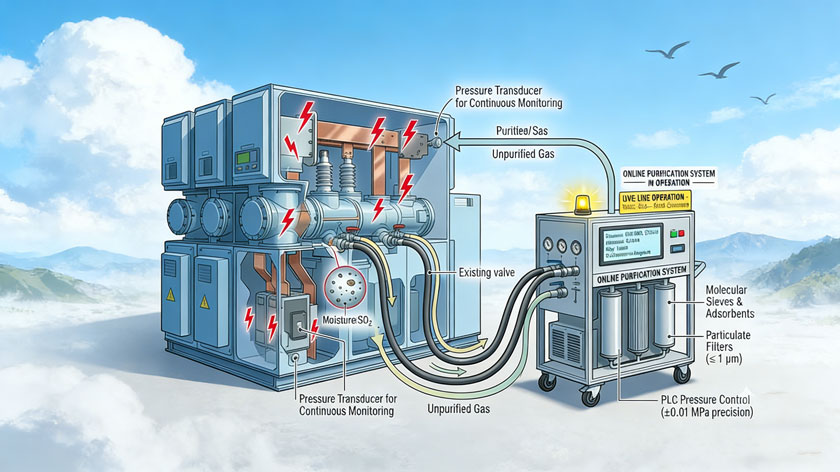
Multi-stage filtration: Removes oil, moisture, and particles (<1 µm).
Chemical adsorbents: Neutralize acidic decomposition byproducts (SO₂, HF).
Fractionating (distillation) column: Separates air, CF₄, and other non-condensable gases from SF₆—essential for achieving >99.9% purity.
Stainless steel purification tank (e.g., 300L) with sufficient residence time for thorough processing.
Systems with only particulate and moisture filters fail on air/CF₄ and decomposition product limits.
✅ 2. Gas Quality Verification
IEC 60480 requires verification—not just treatment. This means:
Onboard analyzers (optional but recommended) for real-time SF₆ purity, dew point, and SO₂ detection.
OR post-recycling lab testing using GC, FTIR, or electrochemical sensors.
Without verification, you cannot confirm compliance, even with a high-end recycler.
✅ 3. Closed-Loop, Oil-Free Design
Oil-free compressors and vacuum pumps prevent hydrocarbon contamination (critical for oil content ≤10 µg/g).
Self-sealing couplings avoid atmospheric ingress during transfer.
Practical Example: DL/T 662–Compliant Systems
Many modern industrial SF₆ recycling units—such as those built to China’s DL/T 662 standard—are engineered to exceed IEC 60480 requirements:
They output gas meeting GB/T 12022, which aligns closely with IEC 60376 for new gas—and thus surpasses IEC 60480.
With an elevating fractionating column, stainless steel purifier, and <1 µm filtration, they effectively remove air, moisture, and arc byproducts.
When paired with optional embedded analyzers, they enable on-site certification of reuse readiness.
🔍 Important: Always request a gas test report after recycling. If your system lacks analytical capability, send a sample to a certified lab before refilling critical GIS equipment.
Conclusion
An on-site SF6 gas recovery and recycling system can meet IEC 60480 standards for direct gas reuse—but only if it combines deep purification (especially fractional distillation), oil-free operation, and verified gas quality testing. Basic recovery carts do not suffice.
For utilities and industrial users, investing in a fully integrated, analyzer-equipped recycling unit ensures regulatory compliance, equipment safety, and true closed-loop sustainability—turning waste SF₆ into a reliable, reusable resource.
Leave A Message
Your email address will not be published. Required fields are marked *
More Articles