Professional Guide to SF6 Vacuum Pumping and Refilling for SF6 Circuit Breakers
Sulfur Hexafluoride (SF6) gas remains the industry standard for high-voltage insulation and arc quenching due to its exceptional dielectric strength and thermal stability. However, maintaining the integrity of this insulation system requires specialized equipment and rigorous procedures.
When performing maintenance or commissioning, SF6 vacuum pumping and refilling for SF6 circuit breakers is the most critical phase. Utilizing high-performance devices, such as the RF-S series Vacuum pumping device, ensures that equipment operating from 10kV to 500kV remains moisture-free and maintains peak operational safety.
1. The Importance of Vacuum Pumping in SF6 Maintenance
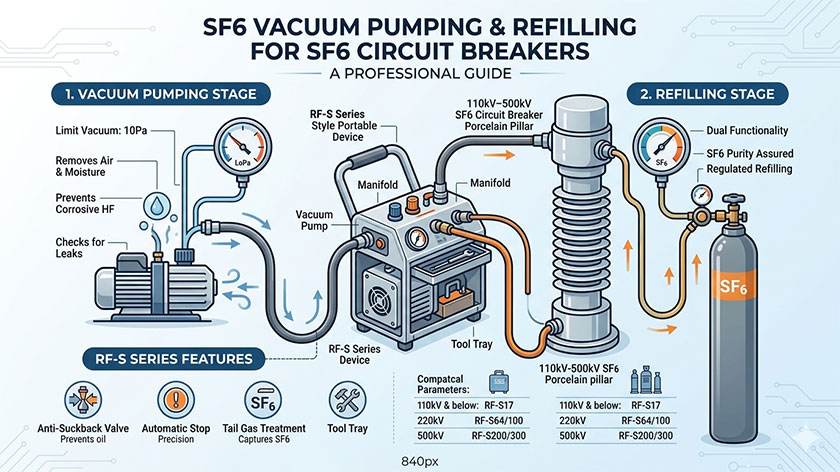
Before refilling a circuit breaker with new or recycled SF6 gas, the internal chamber must be evacuated to a near-total vacuum. This process serves three primary purposes:
Removal of Air and Moisture: Oxygen and moisture are the primary enemies of SF6. Moisture can react with SF6 decomposition products (formed during arcing) to create corrosive hydrofluoric acid (HF).
Ensuring Gas Purity: By reaching a limit vacuum (typically around 10Pa), you ensure that the subsequent gas refill meets the required purity levels for high-voltage insulation.
Leak Detection: Maintaining a stable vacuum over a "holding period" is a standard method to verify the hermetic sealing of the porcelain pillars or GIS tanks.
2. Technical Analysis of the RF-S Series SF6 Vacuum Device
The efficiency of SF6 vacuum pumping and refilling for SF6 circuit breakers depends heavily on the displacement rate and the reliability of the vacuum pump. The RF-S series Vacuum pumping device offers a scalable range of solutions, from the compact RF-S8 (8 cubic meters per hour) to the industrial-scale RF-S300 (300 cubic meters per hour).
Key Features and Advantages
Dual Functionality (Pumping & Refilling): These units are designed for a seamless transition. Once the target vacuum is reached, the integrated manifold allows for regulated refilling from SF6 cylinders to the gas compartment without exposing the system to ambient air.
Advanced Protection Mechanisms:
Anti-Suckback Valve: A critical safety feature. In the event of a power failure, the valve prevents vacuum pump oil from being sucked back into the circuit breaker's clean gas chamber.
Automatic Stop: The system can be programmed to stop once the target vacuum level is reached, preventing unnecessary wear on the pump.
Tail Gas Treatment: To comply with environmental regulations, the vacuum pump includes a treatment device to capture trace SF6 residues.
Comparative Technical Parameters
| Model | Pumping Rate | Weight | Application Scope |
| RF-S8/17 | 8 ~ 17 m³/h | 120-130 kg | 10kV ~ 110kV Equipment |
| RF-S64/100 | 64 ~ 100 m³/h | 260-270 kg | 220kV Porcelain Breakers |
| RF-S200/300 | 200 ~ 300 m³/h | 380-390 kg | 500kV Large Scale GIS |
3. Step-by-Step Procedure: SF6 Vacuum Pumping and Refilling
To achieve professional-grade results, field engineers must follow a standardized workflow.
Phase 1: Preparation and Connection
Ensure the circuit breaker is de-energized and grounded. Connect the RF-S device using high-pressure, vacuum-rated hoses. The use of a tool tray (included in the RF-S series Vacuum pumping device) keeps the workspace organized, preventing debris from entering the couplings.
Phase 2: The Vacuum Descent
Turn on the vacuum pump. For a 220kV porcelain pillar breaker, a pumping rate of at least 64 m³/h is recommended to reach the 10Pa limit vacuum efficiently.
Note: During this stage, monitor the vacuum gauge closely. A rapid drop followed by a plateau might indicate the evaporation of internal moisture.
Phase 3: Vacuum Retention Test
Once the limit vacuum is reached, the pump should be isolated from the system. The vacuum must be held for at least 4 hours (depending on local utility standards) to ensure there is no "vacuum rise," which would indicate a leak or residual moisture.
Phase 4: Precision Refilling
Connect the SF6 gas cylinder to the refill port. Use a pressure regulator to ensure the gas enters the breaker at a controlled velocity. Rapid filling can cause "freezing" at the valve or cause the gas temperature to drop significantly, leading to inaccurate pressure readings.
4. Safety and Environmental Compliance
SF6 is a potent greenhouse gas. Therefore, SF6 vacuum pumping and refilling for SF6 circuit breakers must be performed with zero-leakage tolerance.
CE Certification: All RF-S series units are CE certified, ensuring they meet rigorous international safety and quality standards.
Gas Recovery: While the RF-S series focuses on vacuuming and refilling, it is often used in conjunction with recovery units to ensure no gas is vented into the atmosphere.
Oil Maintenance: The vacuum pump oil must be checked regularly. Contaminated oil reduces the ultimate vacuum depth and can damage the internal components of the pump.
5. Selecting the Right Equipment for Your Voltage Level
Choosing the correct model is vital for operational efficiency.
For 110kV and below: The RF-S17 Vacuum pumping device is the ideal solution—portable enough for mobile maintenance teams but powerful enough to handle standard volumes quickly.
For 500kV Infrastructure: The RF-S300 Vacuum pumping device is indispensable. The massive internal volume of 500kV porcelain breakers requires high-displacement pumps to reduce downtime during critical maintenance windows.
The integrity of the power grid relies on the flawless operation of SF6 circuit breakers. By utilizing the RF-S series SF6 vacuum pumping and refilling technology, utilities can ensure a high-purity gas environment, extend equipment lifespan, and prevent catastrophic failures. With features like anti-back-oil valves, automatic stops, and high-precision vacuum depths of 10Pa, these devices represent the pinnacle of gas handling technology.
Leave A Message
Your email address will not be published. Required fields are marked *
More Articles