SF6 Gas Filling Equipment for GIS: IEC 62271-4 Compliant Solutions for Safe & Precise Charging
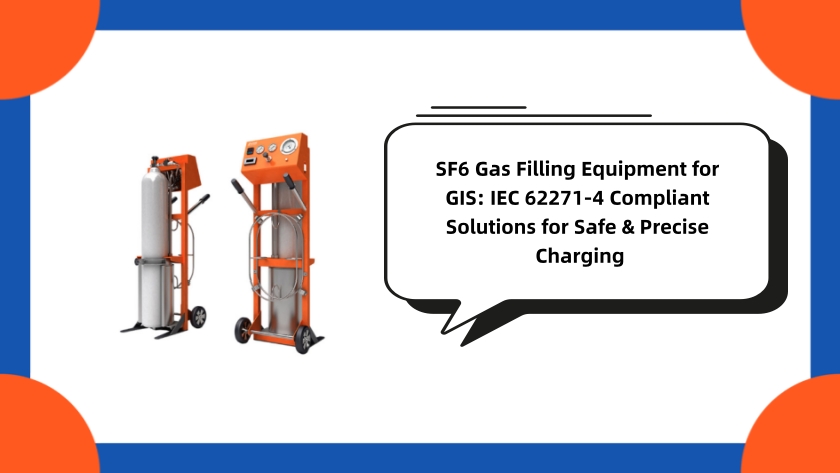
Gas-insulated switchgear (GIS) has become the backbone of modern high-voltage power systems—offering unmatched reliability, compact design, and resilience in urban substations, offshore platforms, and industrial facilities. Central to its performance is sulfur hexafluoride (SF₆), a dielectric gas with exceptional insulating and arc-quenching properties. However, the integrity of GIS depends not only on the quality of the gas but also on the precision and safety of the filling process.
This is where specialized SF6 gas filling equipment for GIS plays a decisive role. Engineered to meet stringent international standards—including IEC 62271-4 and IEC 60480—this equipment ensures that SF₆ is transferred, monitored, and sealed without contamination, leakage, or environmental release. For utilities, EPC contractors, and maintenance teams, investing in certified SF6 gas filling equipment for GIS is not just a technical requirement—it’s a strategic commitment to grid reliability, regulatory compliance, and sustainability.
Why Standard Compressed Air Tools Won’t Suffice
Unlike general-purpose gas handling systems, SF6 gas filling equipment for GIS is purpose-built for the unique demands of high-voltage insulation:
Ultra-high purity requirements: Even trace moisture or air can degrade dielectric strength.
Zero-emission mandates: Venting SF₆ is illegal under EU F-Gas, U.S. EPA, and other global regulations.
Precise pressure control: Over- or under-filling compromises mechanical operation and thermal performance.
Closed-loop operation: All transfers must occur without atmospheric exposure.
Using improvised or non-certified tools risks gas contamination, equipment failure, and significant fines—making purpose-designed filling systems essential.
Core Components of Professional SF6 Gas Filling Equipment for GIS
Modern SF6 gas filling equipment for GIS integrates multiple subsystems into a single, mobile platform:
1. Vacuum Pump System
Before filling, the GIS compartment must be evacuated to ≤1 mbar to remove air and moisture. High-performance dual-stage rotary vane or scroll vacuum pumps ensure deep, stable evacuation—critical for preventing partial discharge.
2. SF₆ Storage and Transfer System
Includes:
Stainless steel pressure vessels for liquid or gaseous SF₆
Oil-free compressors or pressure-regulated transfer lines
Automatic shut-off valves to prevent overfilling
Many units support both liquid-phase (faster) and gas-phase (gentler) filling, depending on GIS manufacturer specifications.
3. Integrated Gas Quality Monitoring
Real-time sensors measure:
Moisture (dew point down to –60°C)
Purity (via thermal conductivity or IR)
Pressure and temperature (for density compensation)
Data is logged digitally for compliance reporting per IEC 62271-4.
4. Leak-Tight Coupling Technology
Quick-connect, self-sealing couplings (e.g., DILO-type) eliminate fugitive emissions during hose attachment—ensuring a truly closed system.
5. Control and Documentation Interface
Touchscreen panels guide operators through standardized procedures, auto-generate filling reports, and store batch numbers, timestamps, and test results for audit trails.
Leading manufacturers like DILO, WIKA, MBW, and GDS offer modular systems that combine all these features in rugged, transportable units—ideal for substation commissioning or emergency maintenance.
Compliance with International Standards
The design and operation of SF6 gas filling equipment for GIS must align with key standards:
IEC 62271-4: Mandates closed-loop handling, personnel training, and documentation for SF₆ use.
IEC 60480: Defines purity thresholds for reused SF₆—requiring pre-fill verification if reclaimed gas is used.
ISO 14064 & GHG Protocol: Require accurate tracking of SF₆ inventory to report Scope 1 emissions.
Equipment that lacks certification or data logging capabilities may pass initial inspection but fail during regulatory audits—exposing organizations to penalties and reputational risk.
Operational Benefits Beyond Compliance
Investing in professional SF6 gas filling equipment for GIS delivers measurable ROI:
Reduced commissioning time: Automated sequences cut filling from hours to minutes.
Lower lifecycle costs: Prevents moisture-induced failures that lead to costly outages.
Enhanced safety: Minimizes technician exposure to decomposed SF₆ byproducts (e.g., SOF₂, HF).
Sustainability gains: Enables safe reuse of purified SF₆, supporting circular economy goals.
For example, a European TSO reported a 30% reduction in GIS-related maintenance calls after standardizing on IEC-compliant filling carts across its fleet.
Choosing the Right Equipment: Key Considerations
When selecting SF6 gas filling equipment for GIS, prioritize:
✅ IEC 62271-4 compliance – Verify third-party certification.
✅ Modularity – Units should support optional analyzers, recovery modules, or battery packs for remote sites.
✅ Ease of use – Intuitive interfaces reduce human error during high-pressure operations.
✅ Service network – Global brands offer calibration, repair, and training—critical for uptime.
✅ Digital integration – Cloud-based logbooks simplify ESG reporting and asset management.
Avoid low-cost “filling kits” that lack vacuum capability, purity monitoring, or leak-tight design—they compromise both safety and performance.
The Future: Smart, Connected, and Sustainable
Next-generation SF6 gas filling equipment for GIS is evolving toward full digitalization:
Bluetooth/Wi-Fi connectivity for real-time data upload
AI-assisted diagnostics to flag abnormal moisture trends
Integration with enterprise asset management (EAM) systems
These innovations not only improve operational efficiency but also provide auditable proof of environmental stewardship—increasingly demanded by investors and regulators alike.
Conclusion: Precision Filling Is Non-Negotiable
In high-voltage power systems, there is no margin for error. The SF6 gas filling equipment for GIS you choose directly impacts equipment lifespan, grid stability, and environmental compliance. By deploying certified, integrated, and intelligent filling systems, utilities and contractors ensure that every GIS installation performs as designed—safely, reliably, and sustainably.
As the industry transitions toward SF₆ alternatives, proper handling of existing gas stocks remains critical. Investing in professional SF6 gas filling equipment for GIS today is an investment in resilience, responsibility, and regulatory readiness for years to come.
Leave A Message
Your email address will not be published. Required fields are marked *
More Articles