Manual vs. Automated SF6 Recovery Systems Efficiency: Driving Operational Excellence in High-Voltage Maintenance
In the modern power utility landscape, the management of Sulfur Hexafluoride (SF6) gas has transitioned from a routine maintenance task to a critical pillar of environmental, social, and governance (ESG) strategy. As global regulators tighten emission standards, the debate between manual vs. automated SF6 recovery systems efficiency has become a focal point for asset managers and substation engineers.
While manual recovery methods have served the industry for decades, the advent of integrated, PLC-controlled automated systems—such as those designed under the DL/T 662 standard—is redefining the benchmarks for speed, safety, and gas purity. This article explores why automation is the superior choice for 72.5kV to 500kV electrical infrastructure maintenance.
1. The Core Conflict: Manual Labor vs. Intelligent Automation
The primary difference in manual vs. automated SF6 recovery systems efficiency lies in the elimination of human error and the optimization of thermodynamics.
The Limitations of Manual Recovery
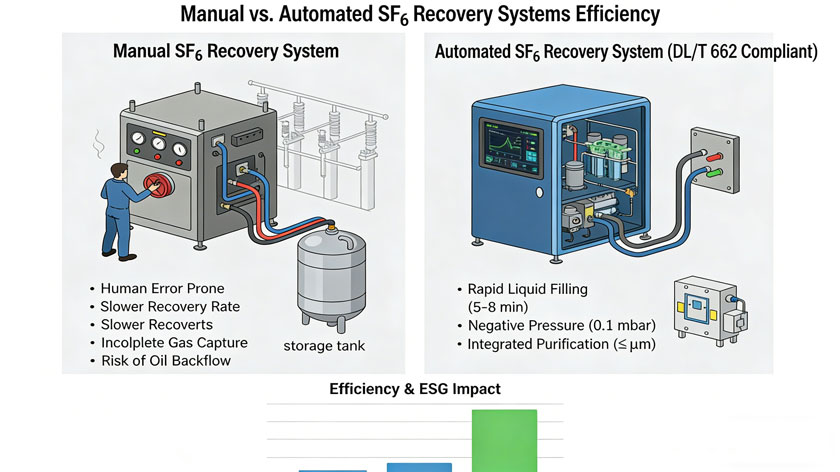
Manual systems require technicians to constantly monitor pressure gauges, manually toggle valves, and estimate the liquefaction rates based on ambient temperatures. This often results in:
Incomplete Recovery: Failure to reach high vacuum levels due to early termination of the recovery cycle.
Risk of Contamination: Accidental "back-oiling" from vacuum pumps if valves are not closed in the correct sequence.
Extended Downtime: Slow processing speeds due to inefficient thermal management during phase transitions.
The Automated Advantage
Automated SF6 recovery systems utilize Programmable Logic Controllers (PLC) to orchestrate the recovery, purification, and refilling phases. By monitoring the "Digital Twin" of the gas state in real-time, these systems ensure that every gram of gas is accounted for without requiring constant operator intervention.
2. Speed and Throughput: Quantitative Efficiency
When analyzing manual vs. automated SF6 recovery systems efficiency, throughput is the most visible metric. For a 500kV porcelain column circuit breaker, the volume of gas is substantial.
High-Performance Compression
Automated systems are typically equipped with oil-free water-cooled compressors (e.g., 15 m3/h capacity). Unlike manual units that may struggle with heat buildup, water-cooled automation maintains a constant recovery rate even in high-ambient-temperature environments.
Rapid Liquid Filling
A hallmark of high-efficiency automated systems is the ability to perform liquid filling at scale. Modern units can fill a 40L cylinder with 50kg of liquid SF6 in just 5 to 8 minutes. In a manual setup, achieving the correct pressure-to-temperature ratio for such rapid liquefaction is nearly impossible without risk to the safety valves.
3. The Science of Purity: Integrated Purification Systems
Efficiency isn't just about speed; it's about the quality of the "Product" (the recovered gas).
Precision Filtration
Automated systems integrate multi-stage filtration directly into the recovery loop. By passing gas through molecular sieves and sintered filters with a particle size less than or equal to 1 micrometer, the system removes:
Moisture (H2O): Preventing the formation of corrosive hydrofluoric acid.
Decomposition Products (SO2/HF): Removing toxic byproducts generated by electrical arcing.
Solid Particles: Protecting the internal seals of expensive GIS equipment.
In manual systems, purification is often a secondary, separate step, which increases the risk of cross-contamination and gas loss during transfer.
4. Environmental Stewardship: Reducing the GWP Footprint
The Global Warming Potential (GWP) of SF6 is approximately 23,500 times that of CO2. Therefore, the "recovery rate" is the most critical environmental metric in the manual vs. automated SF6 recovery systems efficiency comparison.
Negative Pressure Recovery
Automated systems feature an "Auto-Vacuum" and negative pressure recovery function. This allows the system to pull the gas chamber down to an ultimate vacuum (often less than or equal to 0.1 mbar), ensuring that no residual gas is left behind to leak into the atmosphere when the equipment is opened.
Manual systems often stop recovery once the pressure reaches 1 bar (atmospheric), inadvertently leaving a significant percentage of the gas charge inside the equipment.
5. Safety and Reliability: Protecting the Human Asset
A reliable SF6 gas recovery unit must protect the operator as much as the environment.
Anti-Backflow Protection
Manual systems are prone to "pump oil backflow" if a power failure occurs or if a valve is left open. Automated units solve this with electromagnetic anti-backflow valves and PLC-driven shutdown sequences. This ensures that vacuum pump oil never enters the gas storage tank or the switchgear.
Vaporization and Thermal Control
Refilling a GIS in cold weather can cause "freeze-up" in manual hoses. Automated systems integrate 1.5kW vaporizers and heating systems, ensuring that the liquid SF6 transitions safely back to a gas state at the correct temperature, preventing thermal shock to the circuit breaker's insulators.
6. Technical Specifications: The Benchmark for Professional Choice
For procurement officers evaluating manual vs. automated SF6 recovery systems efficiency, the following technical parameters represent the current "Gold Standard" for automated equipment:
| Parameter | Technical Requirement | Benefit of Automation |
| Compressor Type | Oil-free Water-cooled (15 m3/h) | Consistent performance, zero oil contamination. |
| Final Pressure | 50 bar | Enables high-density liquid storage. |
| Filtration Level | less than or equal to 1 micrometer | Ensures gas meets GB/T 12022 standards for reuse. |
| Vacuum Pump | 64 m3/h | Rapid evacuation of large 500kV chambers. |
| Control System | PLC with Touch Screen | Real-time monitoring and data logging for compliance. |
7. Persuasive Conclusion: Why Automation is Non-Negotiable
The transition from manual to automated recovery is not merely a technical upgrade; it is a move toward a more sustainable and cost-effective utility model. While manual systems may have a lower initial purchase price, the "Total Cost of Ownership" tells a different story.
The efficiency gains in manual vs. automated SF6 recovery systems are realized through:
Reduced Labor Costs: One technician can manage a PLC-driven unit, whereas manual recovery often requires a two-person team for safety and monitoring.
Zero Gas Loss: Automated negative pressure recovery saves thousands of dollars in gas replacement costs over the life of the machine.
Extended Asset Life: By returning ultra-pure, dry gas to the switchgear, utilities prevent internal corrosion and expensive GIS repairs.
For any substation managing 72.5kV to 500kV equipment, the automated SF6 recovery system compliant with DL/T 662 is the only logical choice for the modern grid.
Leave A Message
Your email address will not be published. Required fields are marked *
More Articles