Liquefied vs. Gas-State SF6 Storage in SF6 Gas Recovery Unit
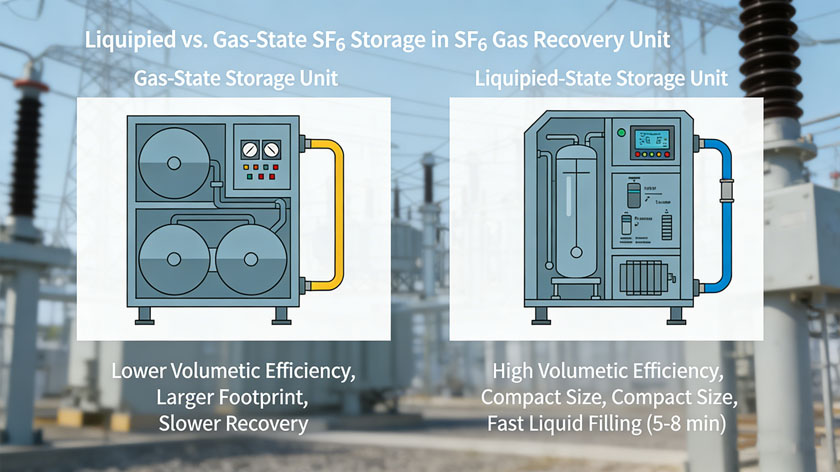
In the specialized field of high-voltage electrical maintenance, the management of Sulfur Hexafluoride (SF6) gas is a critical operational pillar. For utilities managing assets ranging from 72.5kV to 500kV, the efficiency of maintenance downtime often hinges on the performance of their gas handling infrastructure. A central debate among substation engineers involves the methodology of storage: Liquefied vs. gas-state SF6 storage in SF6 gas recovery unit systems.
Choosing the correct storage state is not merely a matter of preference; it dictates the recovery speed, the total footprint of the equipment, and the safety protocols of the substation. This article examines the technical nuances, advantages, and engineering requirements of both storage states within the framework of modern, DL/T 662 compliant recovery units.
1. Defining the States: The Physics of SF6 Recovery
Sulfur Hexafluoride is a heavy, colorless gas with a high critical temperature (45.5 degrees C) and pressure (37.6 bar). Because SF6 transitions relatively easily between phases under pressure, recovery units are designed to exploit these phase changes to maximize efficiency.
Gas-State Storage
Gas-state storage involves keeping the recovered medium in its natural gaseous form within a pressurized vessel. This typically occurs at pressures significantly lower than the liquefaction point. While simpler in terms of hardware requirements, the volumetric density of gas-state storage is low, requiring massive tanks for relatively small amounts of gas.
Liquefied-State Storage
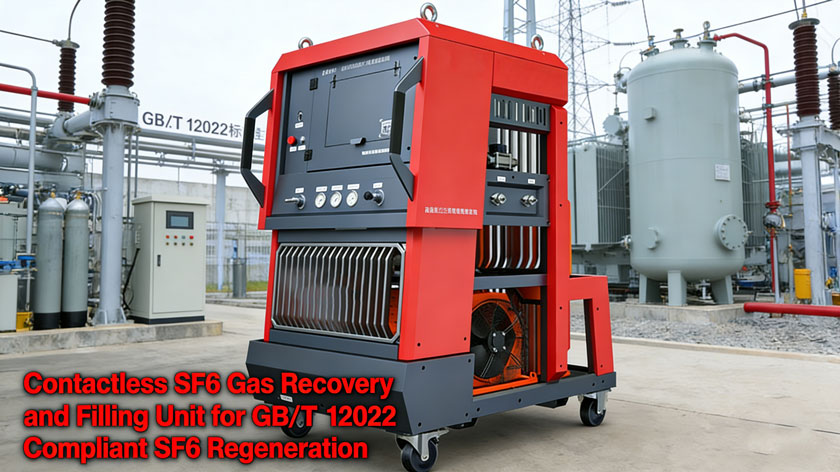
Liquefied storage utilizes high-pressure, oil-free water-cooled compressors to compress the gas until it transitions into a liquid. This state is significantly more compact. Modern recovery units featuring an output final pressure of 50 bar and mechanical refrigeration are optimized for this high-density storage method.
2. Liquefied vs. Gas-State SF6 Storage in SF6 Gas Recovery Unit: Comparative Advantages
When evaluating the liquefied vs. gas-state SF6 storage in SF6 gas recovery unit performance, three primary factors come into play: volumetric efficiency, thermal management, and recovery depth.
Volumetric Density and Footprint
The most immediate advantage of liquefied storage is space. Liquid SF6 has a density of approximately 1400 kg/m3. In contrast, gas-state storage at standard maintenance pressures is far less dense.
Liquefied: A standard 1490mm x 1070mm unit can store hundreds of kilograms of liquid in a relatively small internal tank.
Gas-State: To store the same mass in a gas state would require a vessel several times larger, making the equipment cumbersome and difficult to transport to remote 500kV porcelain column circuit breaker sites.
Recovery Efficiency and "Negative Pressure" Recovery
A high-performance SF6 gas recovery unit must achieve a high recovery rate to minimize environmental emissions.
In gas-state systems, the compressor works harder as the storage tank pressure rises, eventually slowing the recovery of the final remnants of gas from the GIS.
Liquefied systems maintain a more consistent pressure differential because the liquid phase occupies less volume, allowing the unit to utilize its negative pressure recovery function more effectively. This ensures that the gas chamber is emptied more thoroughly, protecting the environment from leakage.
3. High-Speed Liquid Filling and Re-filling
One of the most persuasive arguments for liquefied storage is the speed of re-filling electrical equipment.
The Power of Phase Transition
Modern recovery units are designed to fill a 40L cylinder with 50kg of SF6 in just 5 to 8 minutes. This is only possible through liquefied storage. When the time comes to return the gas to the switchgear, the unit uses an integrated 1.5kW vaporizer and heating system.
Thermal Management in Liquefaction
Liquefaction is an exothermic process (it releases heat). To maintain efficiency, the liquefied vs. gas-state SF6 storage in SF6 gas recovery unit choice requires advanced cooling. High-quality units utilize water-cooled oil-free compressors with a capacity of 15 m3/h. By using water-cooling or auxiliary mechanical refrigeration, the unit can ensure rapid recovery even in high-ambient-temperature regions, preventing the "pressure stall" often seen in low-end gas-state units.
4. Purification and Gas Quality Maintenance
Regardless of the storage state, the quality of the SF6 must be maintained. During the recovery process, the gas is passed through a multi-stage filtration system.
Moisture and Decomposition Products: The unit filters out impurities down to a particle size less than or equal to 1 micrometer.
Liquid Phase Advantage: In liquefied storage, some contaminants are easier to manage. Because the gas is compressed and cooled, moisture tends to drop out of the stream more readily into the desiccant beds, ensuring that the liquid stored is of high purity.
5. Technical Parameters for Procurement Selection
For engineers selecting a system, the technical specifications must align with the intended storage strategy. Below are the benchmarks for a unit capable of high-efficiency liquefied storage:
| Feature | Technical Specification |
| Storage State | High-pressure liquid / Pressurized gas |
| Compressor Type | Oil-free Water-cooled (15 m3/h) |
| Final Output Pressure | 50 bar |
| Vacuum Performance | PLC monitored, prevents oil backflow |
| Heating/Vaporization | 1.5kW integrated system |
| Filtration Precision | less than or equal to 1 micrometer |
6. Safety and Standards: Compliance with DL/T 662
Whether using liquefied vs. gas-state SF6 storage in SF6 gas recovery unit methods, compliance with DL/T 662 is mandatory.
Safety Valves: Liquefied storage tanks must have redundant safety valves and pressure sensors to manage the high pressures associated with liquid SF6.
Anti-Backflow: Vacuum pumps must be equipped with anti-backflow valves to prevent pump oil from contaminating the purified gas stream—a critical requirement for maintaining the dielectric strength of the gas for future use in 500kV breakers.
7. Operational Best Practices for Field Technicians
To maximize the benefits of liquefied storage, technicians should follow these standardized procedures:
Monitor the Vaporizer: When re-filling gas from a liquid-state tank, ensure the 1.5kW vaporizer is fully pre-heated to prevent "freeze-up" of the DN13 filling lines.
Utilize Auxiliary Cooling: In environments exceeding 35 degrees C, always utilize the water-cooling or auxiliary refrigeration options to maintain a high liquefaction rate.
Vacuum Verification: Before every recovery cycle, use the PLC screen to verify the vacuum level of the internal storage tank to prevent air contamination of the stored SF6.
8. Conclusion: The Persuasive Case for Liquefied Storage
In the comparison of liquefied vs. gas-state SF6 storage in SF6 gas recovery unit technologies, liquefied storage emerges as the professional choice for modern power systems. Its ability to store large volumes of gas in a compact, portable footprint, combined with the rapid re-filling speeds enabled by integrated vaporization, makes it indispensable for 110kV to 500kV substation maintenance.
By investing in a recovery unit that features 15 m3/h oil-free compression and 50 bar capability, utility providers ensure they are not only compliant with DL/T 662 but also operating at the highest level of efficiency and environmental responsibility.
Leave A Message
Your email address will not be published. Required fields are marked *
More Articles